Če iščete "kaj so morske alge," verjetno poskušate ugotoviti, ali ta surovina ustreza izdelku ali formulaciji, ki jo razvijate, in kaj bi morali vprašati dobavitelja, preden nadaljujete. Skratka, morske alge so fotosintetični organizmi, ki živijo v morskem okolju. Spadajo v dve veliki skupini: makroalge, ki so morske alge, ki si jih večina ljudi predstavlja, in mikroalge, ki vključujejo fitoplankton in so veliko premajhne, da bi jih videli brez mikroskopa. Industrijski kupci jih pridobivajo kot surovino, ko potrebujejo vložek, ki ga lahko določijo, preizkusijo in zanesljivo pridobivajo skozi čas.
Ta priročnik pokriva osnove v praktičnem vrstnem redu. Začnemo s tem, kako so morske alge razvrščene in kje se zamenjajo običajni izrazi, kot sta "morske alge" in "mikroalge". Nato pogledamo, zakaj industrijski kupci ocenjujejo alge kot vhodni material in kompromise, ki jih tehtajo, zlasti naravno variabilnost v primerjavi s stabilnimi specifikacijami. Nato vam damo specifikacije in kontrolni seznam za nabavo za skupine za nabavo in raziskave in razvoj ter zaključimo z vprašanji, ki jih kupci pogosto postavljajo in kjer je dokazov še vedno malo.
Kaj so morske alge: razvrstitev in glavne skupine
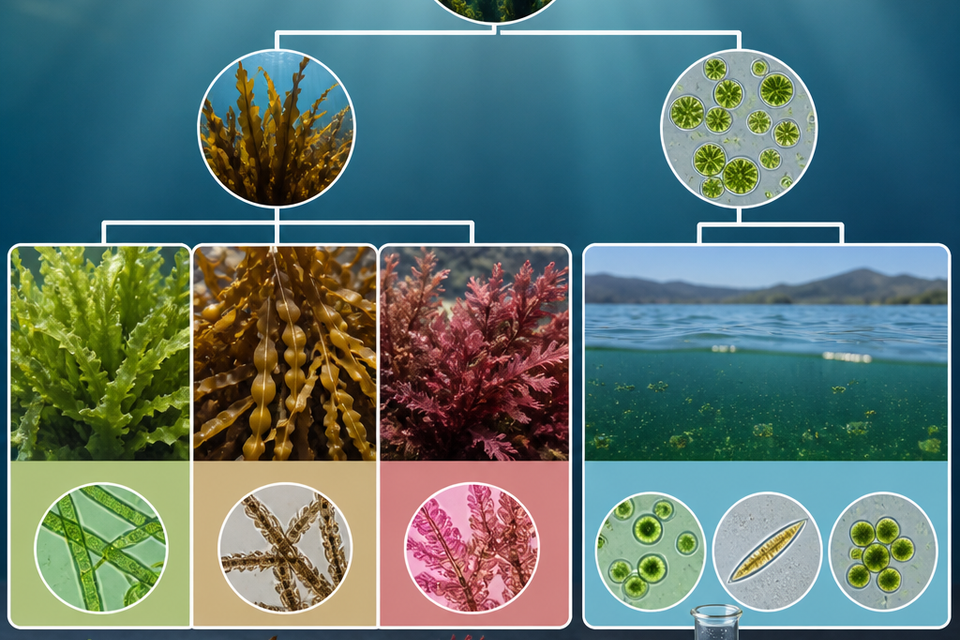
Morske alge so funkcionalna skupina, ne ena družina. Glavne skupine se razlikujejo predvsem po pigmentu, ki določa barvo, globino habitata in industrijski uporabi (hrana, hidrokoloidi, krma, surovina za biogoriva), ki je obravnavana v naslednjih razdelkih.
Morske alge so fotosintetični organizmi, ki rastejo v morski vodi. Spadajo v dve praktični skupini: makroalge, katere so morske alge, ki jih lahko vidite, in mikroalge, ki vključujejo fitoplankton in so običajno nevidni brez mikroskopa. Za kupca se skupina odloči za surovino, dobavno pot in specifikacijo, ki jo napišete.
Začnite s pogoji
Največ zmede povzročajo tri prekrivajoče se besede:
- Morske alge je krovni izraz za alge, ki živijo v slani vodi.
- Morske alge je vsakdanje ime za makroalge. Morske alge so neke vrste alge, ne ločena kategorija.
- Mikroalge so enocelični ali majhni kolonialni organizmi. Fitoplankton so mikroalge, ki se premikajo v vodnem stolpcu.
Če dobavitelj reče "morske alge", vprašajte, katero skupino misli. Specifikacija, ki pravi "izvleček morskih alg", in specifikacija, ki pravi "biomasa mikroalg", opisujeta različne materiale z različnimi potmi pridobivanja in predelave.
Makroalge: rjave, rdeče in zelene
Makroalge so razvrščene po pigmentu in celični zgradbi. Tri glavne skupine se razlikujejo po barvi, polisaharidih, ki jih shranjujejo, in mestu rasti.
- Rjave alge (Phaeophyceae) vključujejo alge in olupine. Njihova barva izvira iz pigmentov, ki prikrijejo klorofil. Rjave alge so glavni komercialni vir alginatov, ki zgostijo in stabilizirajo izdelke.
- Rdeče alge (Rhodophyta) vključujejo vrste, kot so Chondrus in Gracilarija. Njihovi pigmenti jim dajejo rdečkast ton in rastejo v veliko globino. So običajen vir karagenana in agarja.
- Zelene alge (Chlorophyta) vključujejo morsko solato (Ulva). Vsebujejo klorofil v količinah, zaradi katerih so videti zelene. Pogosto rastejo v coni plimovanja, kjer prenašajo spremenljive razmere.
To so splošne razlike. Natančna sestava se spreminja glede na vrsto, sezono in lokacijo žetve, zato imena skupin obravnavajte kot izhodišče za specifikacijo in ne kot jamstvo za vsebino.
Obiščite stran z izdelki morskih alg da vidimo, kako se te skupine pojavljajo v naši ponudbi.
Mikroalge in fitoplankton: drugačen proizvodni model
Mikroalge sledijo drugačni poti kot morske alge. Ne pobirate jih s skal in jih ne gojite na vrvicah. Gojite jih v kontrolirani kulturi, nato koncentrirate in ločite od vode.
Tudi biološka vloga je drugačna. Morske mikroalge (fitoplankton) so prevladujoči primarni proizvajalci v morskih vodah. V odprtem oceanu so edini vir primarne proizvodnje, kar pomeni, da so morski prehranjevalni spleti odvisni od njih. Za kupca je to manj pomembno kot operativno dejstvo: pot mikroalg poteka po rezervoarjih, svetlobi, hranilih in opremi za ločevanje, ne pa v sezoni žetve.
Nekateri bi morda trdili, da so mikroalge vedno boljša možnost, ker rastejo hitreje in v nadzorovanih pogojih. Vendar je ta prednost odvisna od vašega izdelka. Stroški gojenja, oprema za žetev in ciljne spojine spremenijo odgovor.
Praktičen način za pisanje spec
Uporabite ta vrstni red, ko pišete zahtevo za surovino iz morskih alg:
- Poimenujte skupino. Napišite "rjave makroalge", "rdeče makroalge", "zelene makroalge" ali "mikroalge". Izogibajte se samo "morskim algam".
- Poimenujte ciljno spojino ali funkcijo. Alginat, karagenan, beljakovina ali pigment kažejo na različne skupine.
- Navedite vir. Navedite divje pridelano ali gojeno. Te poti prinašajo različna tveganja pri dobavi in doslednosti.
- Nastavite obrazec. Sveže, posušeno, v prahu ali ekstraktu vsaka sprememba ravnanja in stroškov.
- Zahtevajte podatke o testu za posamezno skupino. Zahtevajte podatke o sestavi za skupino, ki ste jo poimenovali, ne generičnega potrdila o "morskih algah".
En primer drage zmede
Tukaj je pogosta napaka, opisana kot hipotetična. Ekipa za formulacijo na kratko napiše "prah morskih alg". Dobavitelj pošilja prašek iz rjavih makroalg, vendar je ekipa za želerno funkcijo potrebovala material iz rdečih alg. Delo na preoblikovanju se nato začne znova. Ime skupine v specifikaciji to preprečuje.
Opombe o proračunu in tveganju
Cene se razlikujejo glede na skupino, vir in obliko, zato tukaj nimamo zanesljivih številk, ki bi jih lahko objavili za vsako skupino. Zahtevajte ponudbe glede na določeno specifikacijo, tako da številke primerjajo isti material.
Načrtujte tudi tveganje. Nekatere vrste morskih alg proizvajajo toksine ali škodijo ribam, cvetenje pa lahko vpliva tako na divji pridelek kot na vodo iz ribogojstva. Za nabavo povprašajte dobavitelje, kako spremljajo območja žetve in kaj naredijo, ko se pojavi cvetenje.
Če niste prepričani, katera skupina ustreza vašemu izdelku, kontaktirajte nas z vašo ciljno funkcijo in lahko vam pomagamo zožiti specifikacijo.
Zakaj industrijski kupci pridobivajo morske alge kot surovino
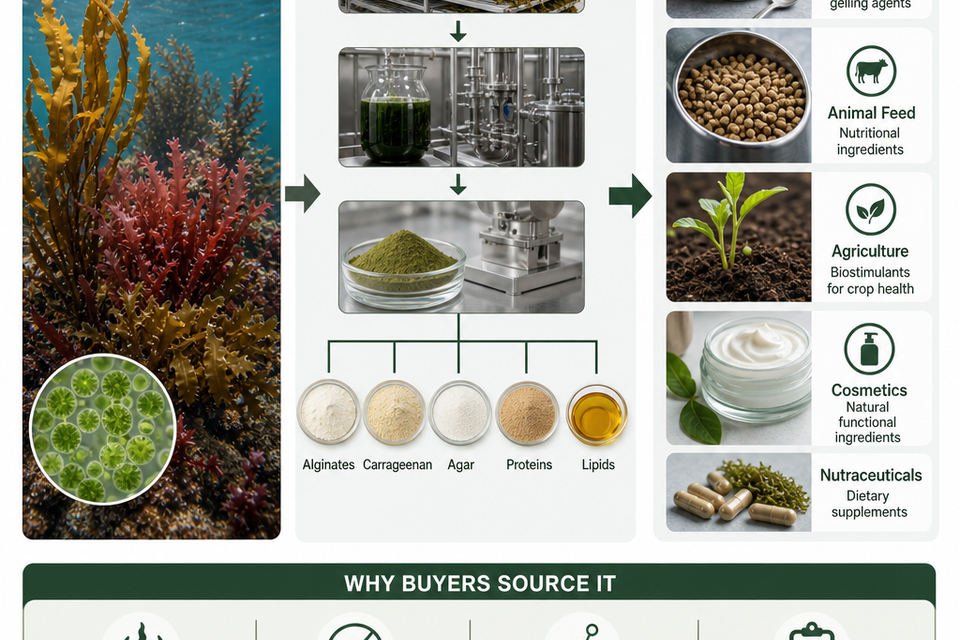
Od oceanske biomase do industrijske sestavine: morske alge postanejo dragocene za kupce B2B, ker so obnovljive, jih je mogoče predelati v konsistentne funkcionalne spojine, kot so alginati, karagenan in agar, in jih je mogoče uporabiti v več industrijskih sektorjih.
Industrijski kupci pridobivajo morske alge, ker lahko zagotovijo vnos biomase, ki ga lahko določijo, preizkusijo in prerazporedijo. Odločilni dejavnik ni splošna privlačnost alg. To je, ali vsaka serija izpolnjuje isto pisno specifikacijo. Če dobavitelj ne more zadržati te specifikacije, bo material v vašem procesu odpovedal, ne glede na to, kako dobro je videti na papirju.
Morske alge so fotosintetični organizmi, ki rastejo v morski vodi. Za namene pridobivanja virov sta pomembni dve široki skupini: makroalge (morske alge, vključno z rjavimi, rdečimi in zelenimi vrstami) in mikroalge (fitoplankton). Dalcon Environmental ugotavlja, da so morske mikroalge prevladujoči primarni proizvajalci v morskih vodah in da je morski ribolov odvisen od njih. Za kupca pa je uporabnejša razlika v tem, kako je posamezna skupina pridelana in pridelana.
Kjer kupci kot vložek ocenjujejo alge
Buyers usually test algae for a small set of uses: food and feed ingredients, personal care formulations, agricultural and aquaculture inputs, and materials still in early development. Each use sets its own specification, such as moisture, particle size, color, microbial limits, contaminant limits, and documentation.
Because these specs differ, a material that fits one use can fail another. Start by naming the use and writing down its limits before you request samples.
Three procurement drivers
Buyers typically reduce their reasons for sourcing to three questions:
- Consistency: Can the supplier hit the same spec on lot 1 and lot 20? Ask for the test methods and the acceptance range for each parameter.
- Supply continuity: Can the supplier deliver the same volume every quarter? Ask where the biomass comes from, how harvest timing is set, and what backup source exists.
- Formulation fit: Does the material run in your current process without changing mixing, drying, or dosing? Ask for samples and a bench trial before you change a recipe.
These questions turn a vague benefit claim into something you can check. A supplier that answers all three with data is easier to qualify than one that answers with marketing language.
The variability trade-off
Algae is a living input. Season, water temperature, nutrient levels, and harvest timing all change composition. The same species can differ from one harvest window to the next.
The cultivation model sets the trade-off between control and cost. Microalgae grown in controlled systems give more room to tighten specs. Macroalgae harvested from open water accept more natural variation. Before you choose a model, compare harvest cost, growth tim
Specification and sourcing checklist for procurement and R&D teams
A usable specification names the algae group, species, harvest method, form, and traceability, then requires lot-level documents to prove each one. Write these fields before you request quotes or run formulation trials. Without them, R&D tests one material and procurement buys another.
Why the spec must come first
Most sourcing problems start with vague words like "seaweed extract" or "marine algae powder." Those words cover brown, red, and green macroalgae and microalgae, which differ in structure, composition, and processing. A sample from one group does not predict the performance of another.
Write the spec before the supplier conversation. It gives both teams one shared definition, and it lets you compare quotes on the same basis.
The specification template
Use this table as a starting point. Fill every row, or mark it as an open question to resolve with the supplier.
| Field | What to write | Zakaj je pomembno |
| Skupina alg | Brown, red, green, or microalgae/phytoplankton | Group drives the end use and the processing route |
| Species or genus | Scientific name, if known | Prevents substitution between look-alike materials |
| Harvest method | Wild harvest, cultivated, or other method the supplier uses | Affects consistency, traceability, and supply continuity |
| Form | Fresh, dried, powder, or extract | Changes handling, storage, dosing, and shelf life |
| Mesto žetve in sezona | Region and harvest window | Composition can shift with environment and season |
| Traceability | Lot numbering and the link from lot to harvest record | Lets you trace a problem back to its source |
| Acceptance range | A min-max range for key attributes your team sets | Turns "good enough" into a checkable test |
| Yield basis | How the supplier calculates yield, and the moisture or dry-weight basis | Prevents comparing quotes that use different bases |
| Lead time | Order-to-delivery time, stated by the supplier | Sets the minimum stock buffer you need |
Specify ranges, not single values. A single target value makes normal lot variation look like a failure.
Questions to ask suppliers
Send these questions in writing. Written answers give you a record to compare later.
- Where is the material harvested, and can you name the region?
- In which months is it harvested, and how do you handle off-season supply?
- What harvest method do you use, and how does it change between lots?
- Can you link each lot number to its harvest record?
- Which lot-level documents do you issue with each shipment?
- What yield figure do you quote, and on what moisture or dry-weight basis?
- What is your standard lead time, and what causes it to slip?
Some suppliers will answer all seven clearly. Others will not. A vague answer to questions 4 and 5 is a warning sign on its own.
Documents to request
Ask every supplier for the documents that cover your specification. Confirm with your regulatory team which standards apply in your target market before you accept any document as sufficient. Common requests include:
- Certificate of analysis for each lot, with results against your acceptance ranges
- Lot traceability record linking the lot to harvest location, date, and method
- Species confirmation or identification record for the material
- Processing record for dried, powdered, or extracted forms
Do not treat a document as proof of quality until your team has checked that it covers the attributes in your spec.
A practical example
Suppose R&D validates a formulation using a sample from one harvest window. Procurement then buys a production lot from a different season, and the lot's composition falls outside the range R&D tested.
The spec would have caught this if it had included a harvest season field and an acceptance range. The fix is simple: require at least three consecutive production lots to fall within your acceptance range before you lock the spec. If lot-to-lot variation exceeds your range, re-test the formulation or tighten the spec before you commit volume.
Some teams argue that a broad spec gives them more supplier options. That holds only for early trials. For production, a broad spec shifts risk onto your formulation, so narrow the spec once trials show which attributes matter.
Budget and implementation risks
Budget context is unclear until you have real quotes. Do not estimate costs from general assumptions. Request quotes against the same spec, with the same yield basis and lead time, so you can compare them directly.
Watch for these implementation risks:
- Species drift: the supplier changes source or species without notice.
- Seasonal gaps: the material is unavailable in certain months, which forces an unplanned switch.
- Documentation gaps: lots ship without the records your spec requires.
- Re-qualification time: a supplier or source change can force new R&D trials, which add time before production.
Build a re-qualification step into your supplier change process. Treat any change in source, species, or form as a new spec event.
Next steps
Start with the stran z izdelki morskih alg to see which forms and groups are covered. Then use the stran za stik z nami to send your completed template for a specification review. If you are still defining a new input, the new raw material development page and the stran o nas explain how the team works with buyers and R&D.
Common buyer pain points and open questions
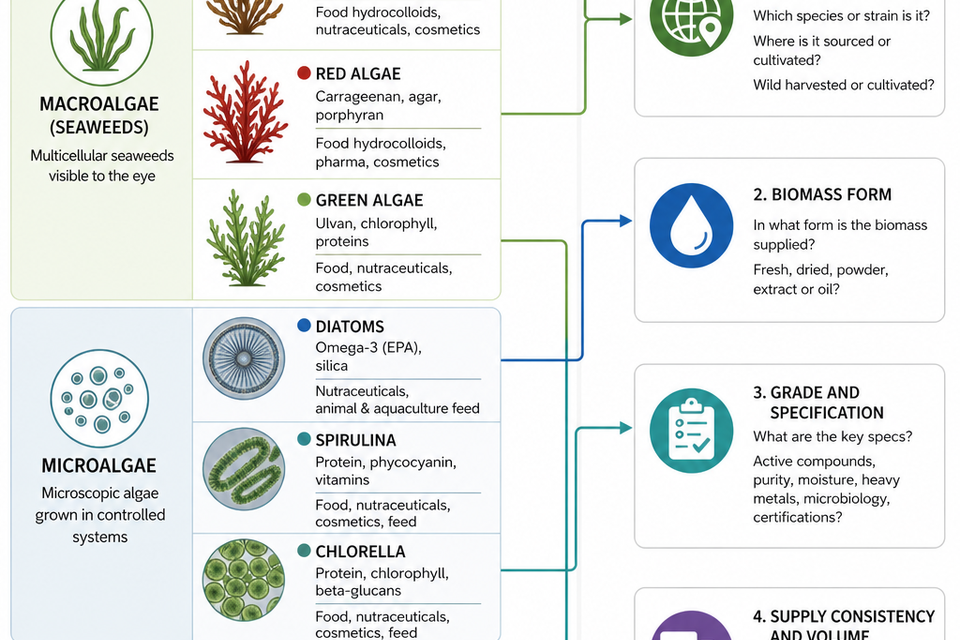
Marine algae is an umbrella term covering very different organisms with different compounds and supply chains. Before sourcing, confirm which group, species, and biomass form your application requires, since these determine specifications, pricing, and supplier fit.
Buyers most often get stuck on three things: batch-to-batch consistency, unclear origin data, and unclear cost per usable unit. You can check all three before you commit to a trial.
Editor note: No forum threads or community discussions were supplied for this section, so the pain points below are framed as common buyer questions. Each needs a cited source before publication.
Pain point 1: One batch performs differently from the next
Marine algae are biological materials. Composition shifts with species, harvest timing, and water conditions. A strong sample tells you little about the lot that arrives six months later.
Ask for a lot-level certificate of analysis with every shipment. Compare at least three consecutive lots before you scale up.
Pain point 2: Origin data is vague
"Marine algae" covers brown, red, and green macroalgae, plus microalgae (phytoplankton). These groups differ in how they grow, how they are harvested, and how long they take to reach harvest size. Wild-harvested and cultivated material can also look similar on a spec sheet.
Treat an origin question as a production-model question. Ask:
- Is the material wild-harvested or cultivated?
- If cultivated, is it open-ocean or land-based?
- Where and when was this lot harvested?
Pain point 3: Cost per usable unit is hard to compare
Quotes often list price per kilogram of wet or dried biomass. That number hides yield. If Supplier B costs 20% more per kilogram but delivers 25% more of the active material you need, B is the cheaper option.
Convert every quote to cost per kilogram of usable material. Then compare quotes on the same basis.
Pain point 4: Implementation risks get little attention
Buyers rarely ask how a supplier handles contamination or toxic blooms. For aquaculture and seafood operators, this matters because some species produce toxins or harm fish. Ask suppliers:
- Which contaminants and species do they test for?
- What happens to a lot that fails testing?
- How do they notify customers about a problem lot?
How to verify claims before a trial
- Request the species name (Latin binomial) and the lot certificate.
- Ask for harvest site, date, and production method.
- Write a spec for the properties you need and agree on test methods upfront.
- Run a small trial and keep retained samples from each lot.
- Test at least three lots before you commit to volume.
Where evidence is still thin
Published comparisons of yield, harvest cost, and scalability across production models are limited in the sources reviewed for this section. Do not treat any supplier's yield or cost claim as settled until they provide their own data. Ask for the test method behind each number.
For a broader view of the material types, visit our morske alge page. If you need help matching a spec to a raw material, see our page on razvoj novih surovin. For company background, read our about us page. For technical questions about your application, kontaktirajte nas.
Zaključek
Marine algae are a broad category, so the first step is knowing which group you're actually dealing with. Macroalgae, microalgae, and phytoplankton behave differently in cultivation, harvesting, and specification, and mixing them up is one of the fastest ways to end up with the wrong inputs. From there, most sourcing decisions come down to specifications you can verify: the algae group, form, harvest method, traceability, and lot-level documentation. Natural variability is real, so build your specs and testing plan around it rather than hoping it won't show up.
If you're at the stage of comparing inputs, start by writing down your specification fields using the checklist above, then review the marine algae product page to see how the options line up. If you have technical questions or want to request specifications for a trial, reach out through our contact page. You can also look at our new raw material development page if you're evaluating an input that isn't yet in your standard range.
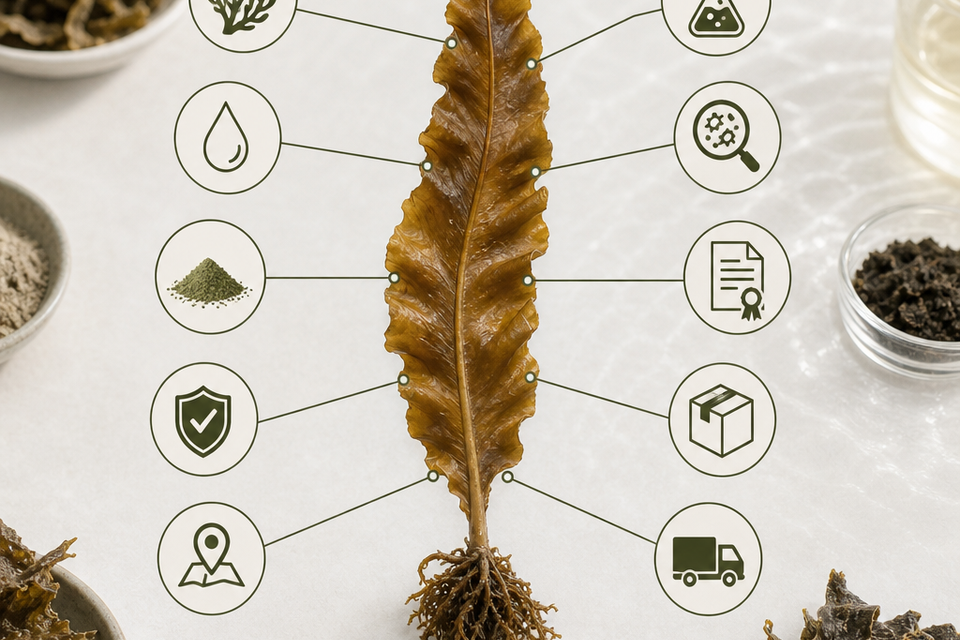
Use this checklist to define marine algae specifications before supplier qualification. Items marked as must-verify, such as species identity, contaminant limits, and Certificates of Analysis, should be confirmed in writing for every lot, because differences in form, origin, or processing can change both functional performance and regulatory compliance.