Nëse jeni duke kërkuar për "çfarë është algat detare", ndoshta po përpiqeni të kuptoni nëse kjo lëndë e parë i përshtatet një produkti apo formulimit që po zhvilloni dhe çfarë duhet të pyesni një furnizues përpara se të shkoni më tej. Me pak fjalë, algat detare janë organizma fotosintetikë që jetojnë në mjedise detare. Ato ndahen në dy grupe të gjera: makroalgat, të cilat janë algat e detit që i paraqesin shumica e njerëzve, dhe mikroalgat, të cilat përfshijnë fitoplankton dhe janë shumë të vogla për t'u parë pa mikroskop. Blerësit industrialë i marrin ato si lëndë të parë kur kanë nevojë për një input që mund ta specifikojnë, testojnë dhe burimin në mënyrë të besueshme me kalimin e kohës.
Ky udhëzues mbulon bazat në një mënyrë praktike. Fillojmë me mënyrën se si klasifikohen algat detare dhe ku ngatërrohen termat e zakonshëm si "alga deti" dhe "mikroalga". Më pas, ne shikojmë pse blerësit industrial i vlerësojnë algat si një input dhe kompensimet që ato peshojnë, veçanërisht ndryshueshmërinë natyrore kundrejt specifikimeve të qëndrueshme. Më pas ne ju japim një listë kontrolli të specifikimeve dhe burimeve për ekipet e prokurimit dhe R&D, dhe përfundojmë me pyetjet që shpesh ngrenë blerësit dhe ku provat janë ende të pakta.
Cilat janë algat detare: klasifikimi dhe grupet kryesore
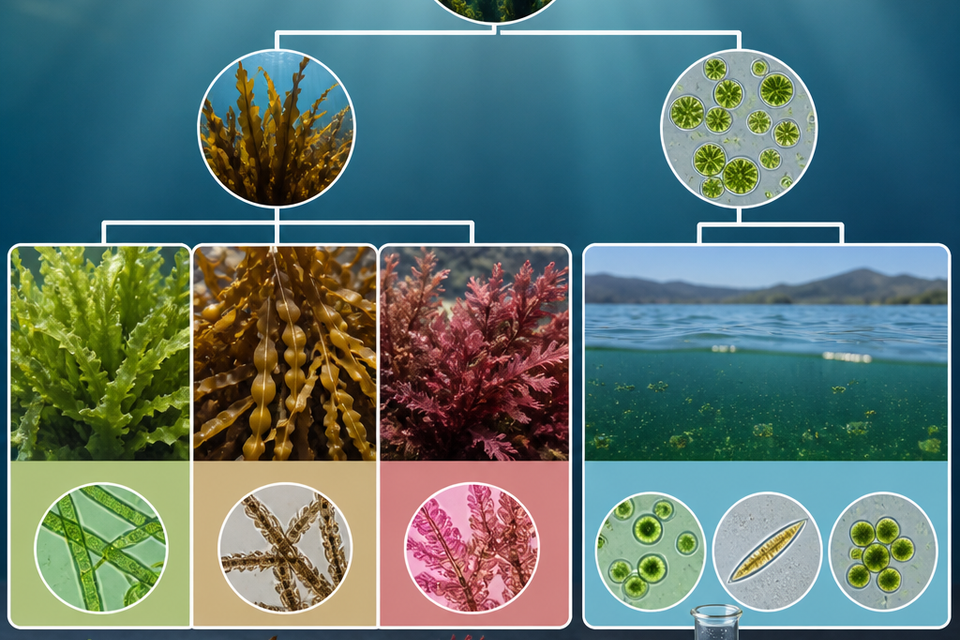
Algat detare janë një grupim funksional, jo një familje e vetme. Grupet kryesore dallohen kryesisht nga pigmenti, i cili përcakton ngjyrën, thellësinë e habitatit dhe përdorimet industriale (ushqimi, hidrokoloidet, ushqimet, lëndët ushqyese të biokarburanteve) të mbuluara në seksionet e mëposhtme.
Algat detare janë organizma fotosintetikë që rriten në ujin e detit. Ato ndahen në dy grupe praktike: makroalgat, cilat janë alga deti që mund të shihni, dhe mikroalgave, të cilat përfshijnë fitoplankton dhe zakonisht janë të padukshëm pa mikroskop. Për një blerës, grupi vendos lëndën e parë, rrugën e furnizimit dhe specifikat që shkruani.
Filloni me termat
Shumica e konfuzionit vjen nga tre fjalë të mbivendosura:
- Algat detare është termi ombrellë për algat që jetojnë në ujërat e kripura.
- Alga deti është emri i përditshëm për makroalgat. Alga deti është një lloj alge, jo një kategori më vete.
- Mikroalgat janë organizma njëqelizorë ose të vegjël kolonialë. Fitoplanktoni janë mikroalgat që lëvizin në kolonën e ujit.
Nëse një furnizues thotë "alga detare", pyesni për cilin grup nënkuptojnë. Një specifikim që thotë "ekstrakt i algave të detit" dhe një specifikim që thotë "biomasa mikroalgash" përshkruajnë materiale të ndryshme, me rrugë të ndryshme burimi dhe përpunimi.
Makroalgat: kafe, e kuqe dhe jeshile
Makroalgat klasifikohen sipas pigmentit dhe strukturës së qelizave. Tre grupet kryesore ndryshojnë në ngjyrë, polisaharidet që ruajnë dhe ku rriten.
- Algat kafe (Phaeophyceae) përfshijnë leshterik dhe gërvishtje. Ngjyra e tyre vjen nga pigmentet që maskojnë klorofilin. Algat kafe janë burimi kryesor tregtar i alginateve, të cilat trasjnë dhe stabilizojnë produktet.
- Algat e kuqe (Rhodophyta) përfshijnë specie si Kondrus dhe Gracilaria. Pigmentet e tyre u japin atyre një ton të kuqërremtë dhe ato rriten në shumë thellësi. Ato janë burimi i zakonshëm i karragjenanit dhe agarit.
- Algat jeshile (Chlorophyta) përfshijnë marule deti (Ulva). Ato përmbajnë klorofil në sasi që i bëjnë ato të duken jeshile. Ata shpesh rriten në zonën intertidal, ku tolerojnë ndryshimin e kushteve.
Këto janë dallime të përgjithshme. Përbërja e saktë ndryshon me speciet, stinën dhe vendndodhjen e korrjes, prandaj trajtojini emrat e grupeve si pikënisje për specifikim, jo si garanci për përmbajtjen.
Vizitoni Faqja e produktit të algave detare për të parë se si shfaqen këto grupe në gamën tonë.
Mikroalgat dhe fitoplanktoni: një model i ndryshëm prodhimi
Mikroalgat ndjekin një rrugë të ndryshme nga alga deti. Ju nuk i korrni ato nga shkëmbinjtë ose nuk i kultivoni ato në linja. Ju i rritni ato në kulturë të kontrolluar, më pas i përqendroni dhe i ndani nga uji.
Roli biologjik gjithashtu ndryshon. Mikroalgat detare (fitoplanktoni) janë prodhuesit kryesorë dominues në ujërat detare. Në oqeanin e hapur, ato janë burimi i vetëm i prodhimit primar, që do të thotë se rrjetat ushqimore detare varen prej tyre. Për një blerës, kjo ka më pak rëndësi se fakti operacional: rruga e mikroalgave shkon në rezervuarë, dritë, lëndë ushqyese dhe pajisje ndarëse, jo në sezonin e korrjes.
Disa mund të argumentojnë se mikroalgat janë gjithmonë alternativa më e mirë sepse ato rriten më shpejt dhe në kushte të kontrolluara. Sidoqoftë, ky avantazh varet nga produkti juaj. Kostot e kultivimit, pajisjet e korrjes dhe komponimet e synuara ndryshojnë të gjitha përgjigjen.
Një mënyrë praktike për të shkruar specifikat
Përdorni këtë urdhër kur shkruani një kërkesë për një lëndë të parë të algave detare:
- Emërtoni grupin. Shkruani "makroalga kafe", "makroalga të kuqe", "makroalga jeshile" ose "mikroalga". Shmangni vetëm "alga deti".
- Emërtoni përbërjen ose funksionin e synuar. Alginati, karragjenani, proteina ose pigmenti secila pikë në grupe të ndryshme.
- Tregoni burimin. Specifikoni të korrur ose të kultivuar të egër. Këto rrugë mbartin rreziqe të ndryshme të furnizimit dhe konsistencës.
- Vendosni formularin. Të freskëta, të thara, pluhur ose ekstrakte për trajtimin dhe koston e çdo ndryshimi.
- Kërkoni të dhëna testimi specifike për grupin. Kërkoni të dhëna kompozicionale për grupin që përmendët, jo një certifikatë të përgjithshme "alga detare".
Një shembull i një përzierjeje të kushtueshme
Këtu është një gabim i zakonshëm, i përshkruar si hipotetik. Një ekip formulimi shkruan "pluhurin e algave detare" në një përmbledhje të shkurtër. Furnizuesi dërgon një pluhur makroalgesh kafe, por ekipit i nevojitej një material algash të kuqe për funksionin e xhelit. Puna e riformulimit fillon nga e para. Një emër grupi në specifikim e parandalon këtë.
Buxheti dhe shënimet e rrezikut
Çmimi ndryshon sipas grupit, burimit dhe formës, dhe ne nuk kemi shifra të besueshme për të publikuar këtu për secilin grup. Kërkoni kuota kundër një specifikimi specifik në mënyrë që numrat të krahasojnë të njëjtin material.
Planifikoni gjithashtu për rrezikun. Disa lloje algash detare prodhojnë toksina ose dëmtojnë peshqit, dhe lulëzimi mund të ndikojë si në të korrat e egra ashtu edhe në ujin e akuakulturës. Për burime, pyesni furnitorët se si monitorojnë zonat e korrjes dhe çfarë bëjnë kur shfaqet një lulëzim.
Nëse nuk jeni të sigurt se cili grup i përshtatet produktit tuaj, na kontaktoni me funksionin tuaj të synuar dhe ne mund t'ju ndihmojmë të ngushtoni specifikimet.
Pse blerësit industrialë marrin algat detare si lëndë të parë
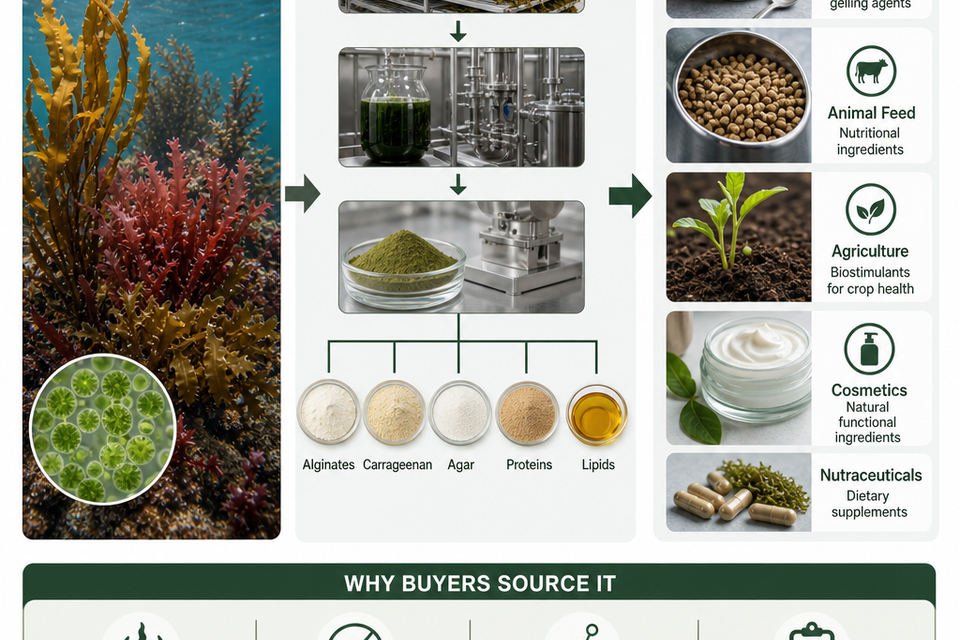
Nga biomasa e oqeanit te përbërësi industrial: algat detare bëhen të vlefshme për blerësit B2B sepse janë të rinovueshme, të përpunueshme në përbërje funksionale të qëndrueshme si alginatet, karragjenani dhe agari dhe të përdorshme në shumë sektorë industrialë.
Blerësit industrialë marrin algat detare sepse ato mund të ofrojnë një input të biomasës që ata mund të specifikojnë, testojnë dhe rirenditin. Faktori vendimtar nuk është tërheqja e përgjithshme e algave. Është nëse çdo grup plotëson të njëjtin specifikim të shkruar. Nëse një furnizues nuk mund ta mbajë atë specifikim, materiali do të dështojë në procesin tuaj, pavarësisht se sa mirë duket në letër.
Algat detare janë organizma fotosintetikë që rriten në ujin e detit. Për qëllime burimore, kanë rëndësi dy grupe të gjera: makroalgat (alga deti, duke përfshirë llojet kafe, të kuqe dhe jeshile) dhe mikroalgave (fitoplankton). Dalcon Environmental vëren se mikroalgat detare janë prodhuesit kryesorë dominues në ujërat detare dhe se peshkimi detar varet prej tyre. Megjithatë, për një blerës, dallimi më i dobishëm është se si rritet dhe korret secili grup.
Ku blerësit vlerësojnë algat si një input
Blerësit zakonisht testojnë algat për një grup të vogël përdorimesh: përbërësit e ushqimit dhe ushqimit, formulimet e kujdesit personal, inputet bujqësore dhe akuakulturore dhe materialet ende në zhvillim të hershëm. Çdo përdorim vendos specifikimet e veta, të tilla si lagështia, madhësia e grimcave, ngjyra, kufijtë mikrobial, kufijtë e ndotësve dhe dokumentacioni.
Për shkak se këto specifika ndryshojnë, një material që i përshtatet një përdorimi mund të dështojë në një tjetër. Filloni duke emërtuar përdorimin dhe duke shkruar kufijtë e tij përpara se të kërkoni mostra.
Tre drejtues prokurimi
Blerësit zakonisht reduktojnë arsyet e tyre për burimin në tre pyetje:
- Konsistenca: A mundet furnizuesi të arrijë të njëjtat specifika në lotin 1 dhe lotin 20? Kërkoni metodat e testimit dhe diapazonin e pranimit për secilin parametër.
- Vazhdimësia e furnizimit: A mundet furnizuesi të japë të njëjtin vëllim çdo tremujor? Pyesni se nga vjen biomasa, si është caktuar koha e korrjes dhe çfarë burimi rezervë ekziston.
- Përshtatja e formulimit: A funksionon materiali në procesin tuaj aktual pa ndryshuar përzierjen, tharjen ose dozimin? Kërkoni mostra dhe një provë në stol përpara se të ndryshoni një recetë.
Këto pyetje e kthejnë një pretendim të paqartë përfitimi në diçka që mund ta kontrolloni. Një furnizues që u përgjigjet të treve me të dhëna është më i lehtë për t'u kualifikuar sesa ai që përgjigjet me gjuhën e marketingut.
Kompensimi i ndryshueshmërisë
Algae is a living input. Season, water temperature, nutrient levels, and harvest timing all change composition. The same species can differ from one harvest window to the next.
The cultivation model sets the trade-off between control and cost. Microalgae grown in controlled systems give more room to tighten specs. Macroalgae harvested from open water accept more natural variation. Before you choose a model, compare harvest cost, growth tim
Specification and sourcing checklist for procurement and R&D teams
A usable specification names the algae group, species, harvest method, form, and traceability, then requires lot-level documents to prove each one. Write these fields before you request quotes or run formulation trials. Without them, R&D tests one material and procurement buys another.
Why the spec must come first
Most sourcing problems start with vague words like "seaweed extract" or "marine algae powder." Those words cover brown, red, and green macroalgae and microalgae, which differ in structure, composition, and processing. A sample from one group does not predict the performance of another.
Write the spec before the supplier conversation. It gives both teams one shared definition, and it lets you compare quotes on the same basis.
The specification template
Use this table as a starting point. Fill every row, or mark it as an open question to resolve with the supplier.
| Field | What to write | Pse ka rëndësi |
| Grupi i algave | Brown, red, green, or microalgae/phytoplankton | Group drives the end use and the processing route |
| Species or genus | Scientific name, if known | Prevents substitution between look-alike materials |
| Harvest method | Wild harvest, cultivated, or other method the supplier uses | Affects consistency, traceability, and supply continuity |
| Form | Fresh, dried, powder, or extract | Changes handling, storage, dosing, and shelf life |
| Vendndodhja dhe stina e korrjes | Region and harvest window | Composition can shift with environment and season |
| Traceability | Lot numbering and the link from lot to harvest record | Lets you trace a problem back to its source |
| Acceptance range | A min-max range for key attributes your team sets | Turns "good enough" into a checkable test |
| Yield basis | How the supplier calculates yield, and the moisture or dry-weight basis | Prevents comparing quotes that use different bases |
| Lead time | Order-to-delivery time, stated by the supplier | Sets the minimum stock buffer you need |
Specify ranges, not single values. A single target value makes normal lot variation look like a failure.
Questions to ask suppliers
Send these questions in writing. Written answers give you a record to compare later.
- Where is the material harvested, and can you name the region?
- In which months is it harvested, and how do you handle off-season supply?
- What harvest method do you use, and how does it change between lots?
- Can you link each lot number to its harvest record?
- Which lot-level documents do you issue with each shipment?
- What yield figure do you quote, and on what moisture or dry-weight basis?
- What is your standard lead time, and what causes it to slip?
Some suppliers will answer all seven clearly. Others will not. A vague answer to questions 4 and 5 is a warning sign on its own.
Documents to request
Ask every supplier for the documents that cover your specification. Confirm with your regulatory team which standards apply in your target market before you accept any document as sufficient. Common requests include:
- Certificate of analysis for each lot, with results against your acceptance ranges
- Lot traceability record linking the lot to harvest location, date, and method
- Species confirmation or identification record for the material
- Processing record for dried, powdered, or extracted forms
Do not treat a document as proof of quality until your team has checked that it covers the attributes in your spec.
A practical example
Suppose R&D validates a formulation using a sample from one harvest window. Procurement then buys a production lot from a different season, and the lot's composition falls outside the range R&D tested.
The spec would have caught this if it had included a harvest season field and an acceptance range. The fix is simple: require at least three consecutive production lots to fall within your acceptance range before you lock the spec. If lot-to-lot variation exceeds your range, re-test the formulation or tighten the spec before you commit volume.
Some teams argue that a broad spec gives them more supplier options. That holds only for early trials. For production, a broad spec shifts risk onto your formulation, so narrow the spec once trials show which attributes matter.
Budget and implementation risks
Budget context is unclear until you have real quotes. Do not estimate costs from general assumptions. Request quotes against the same spec, with the same yield basis and lead time, so you can compare them directly.
Watch for these implementation risks:
- Species drift: the supplier changes source or species without notice.
- Seasonal gaps: the material is unavailable in certain months, which forces an unplanned switch.
- Documentation gaps: lots ship without the records your spec requires.
- Re-qualification time: a supplier or source change can force new R&D trials, which add time before production.
Build a re-qualification step into your supplier change process. Treat any change in source, species, or form as a new spec event.
Next steps
Start with the Faqja e produktit të algave detare to see which forms and groups are covered. Then use the na kontaktoni faqen to send your completed template for a specification review. If you are still defining a new input, the new raw material development page and the faqe rreth nesh explain how the team works with buyers and R&D.
Common buyer pain points and open questions
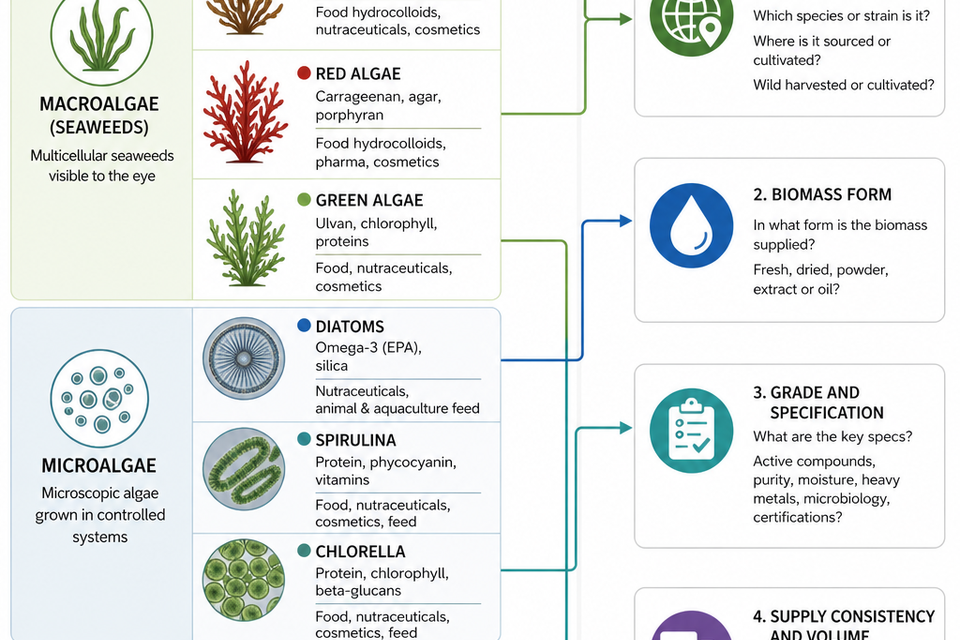
Marine algae is an umbrella term covering very different organisms with different compounds and supply chains. Before sourcing, confirm which group, species, and biomass form your application requires, since these determine specifications, pricing, and supplier fit.
Buyers most often get stuck on three things: batch-to-batch consistency, unclear origin data, and unclear cost per usable unit. You can check all three before you commit to a trial.
Editor note: No forum threads or community discussions were supplied for this section, so the pain points below are framed as common buyer questions. Each needs a cited source before publication.
Pain point 1: One batch performs differently from the next
Marine algae are biological materials. Composition shifts with species, harvest timing, and water conditions. A strong sample tells you little about the lot that arrives six months later.
Ask for a lot-level certificate of analysis with every shipment. Compare at least three consecutive lots before you scale up.
Pain point 2: Origin data is vague
"Marine algae" covers brown, red, and green macroalgae, plus microalgae (phytoplankton). These groups differ in how they grow, how they are harvested, and how long they take to reach harvest size. Wild-harvested and cultivated material can also look similar on a spec sheet.
Treat an origin question as a production-model question. Ask:
- Is the material wild-harvested or cultivated?
- If cultivated, is it open-ocean or land-based?
- Where and when was this lot harvested?
Pain point 3: Cost per usable unit is hard to compare
Quotes often list price per kilogram of wet or dried biomass. That number hides yield. If Supplier B costs 20% more per kilogram but delivers 25% more of the active material you need, B is the cheaper option.
Convert every quote to cost per kilogram of usable material. Then compare quotes on the same basis.
Pain point 4: Implementation risks get little attention
Buyers rarely ask how a supplier handles contamination or toxic blooms. For aquaculture and seafood operators, this matters because some species produce toxins or harm fish. Ask suppliers:
- Which contaminants and species do they test for?
- What happens to a lot that fails testing?
- How do they notify customers about a problem lot?
How to verify claims before a trial
- Request the species name (Latin binomial) and the lot certificate.
- Ask for harvest site, date, and production method.
- Write a spec for the properties you need and agree on test methods upfront.
- Run a small trial and keep retained samples from each lot.
- Test at least three lots before you commit to volume.
Where evidence is still thin
Published comparisons of yield, harvest cost, and scalability across production models are limited in the sources reviewed for this section. Do not treat any supplier's yield or cost claim as settled until they provide their own data. Ask for the test method behind each number.
For a broader view of the material types, visit our algat detare page. If you need help matching a spec to a raw material, see our page on zhvillimi i lëndës së parë të re. For company background, read our about us page. For technical questions about your application, na kontaktoni.
konkluzioni
Marine algae are a broad category, so the first step is knowing which group you're actually dealing with. Macroalgae, microalgae, and phytoplankton behave differently in cultivation, harvesting, and specification, and mixing them up is one of the fastest ways to end up with the wrong inputs. From there, most sourcing decisions come down to specifications you can verify: the algae group, form, harvest method, traceability, and lot-level documentation. Natural variability is real, so build your specs and testing plan around it rather than hoping it won't show up.
If you're at the stage of comparing inputs, start by writing down your specification fields using the checklist above, then review the marine algae product page to see how the options line up. If you have technical questions or want to request specifications for a trial, reach out through our contact page. You can also look at our new raw material development page if you're evaluating an input that isn't yet in your standard range.
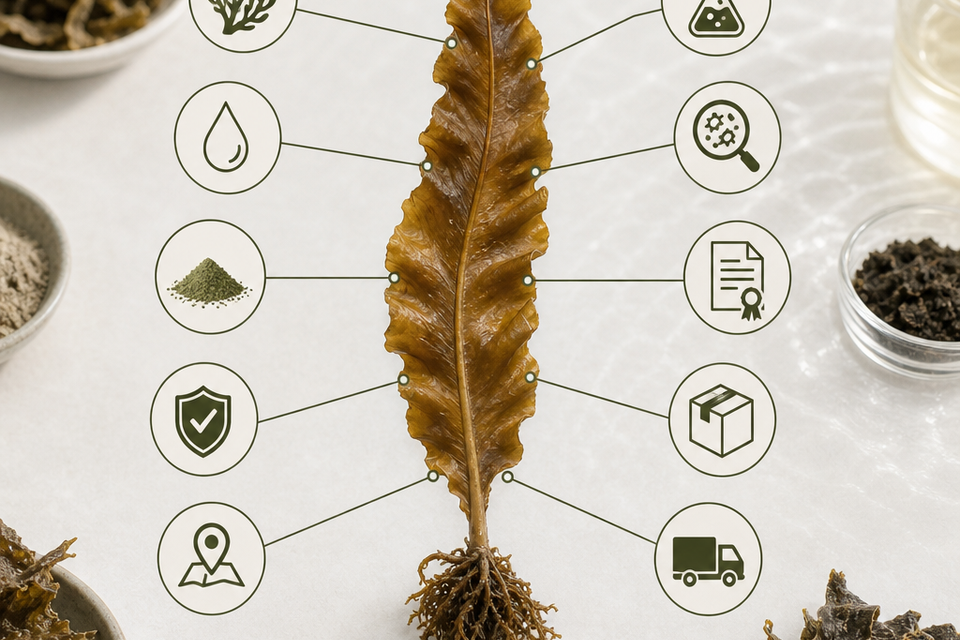
Use this checklist to define marine algae specifications before supplier qualification. Items marked as must-verify, such as species identity, contaminant limits, and Certificates of Analysis, should be confirmed in writing for every lot, because differences in form, origin, or processing can change both functional performance and regulatory compliance.