如果您正在搜索“什么是海藻”,您可能会尝试弄清楚这种原材料是否适合您正在开发的产品或配方,以及在进一步操作之前您需要向供应商询问什么。简而言之,海藻是生活在海洋环境中的光合生物。它们分为两大类:大型藻类,即大多数人想象中的海藻,以及微藻,其中包括浮游植物,如果不使用显微镜就无法看到,它们太小了。当工业买家需要可以长期可靠地指定、测试和采购的输入时,他们会将它们作为原材料进行采购。
本指南按实用顺序介绍了基础知识。我们从海洋藻类的分类方式以及“海藻”和“微藻”等常见术语容易混淆的地方开始。接下来,我们研究为什么工业买家将藻类作为一种投入进行评估,以及他们的权衡,特别是自然变化与稳定规格的权衡。然后,我们为采购和研发团队提供规格和采购清单,并以买家经常提出的问题和证据仍然薄弱的问题作为结尾。
海藻是什么:分类和主要类群
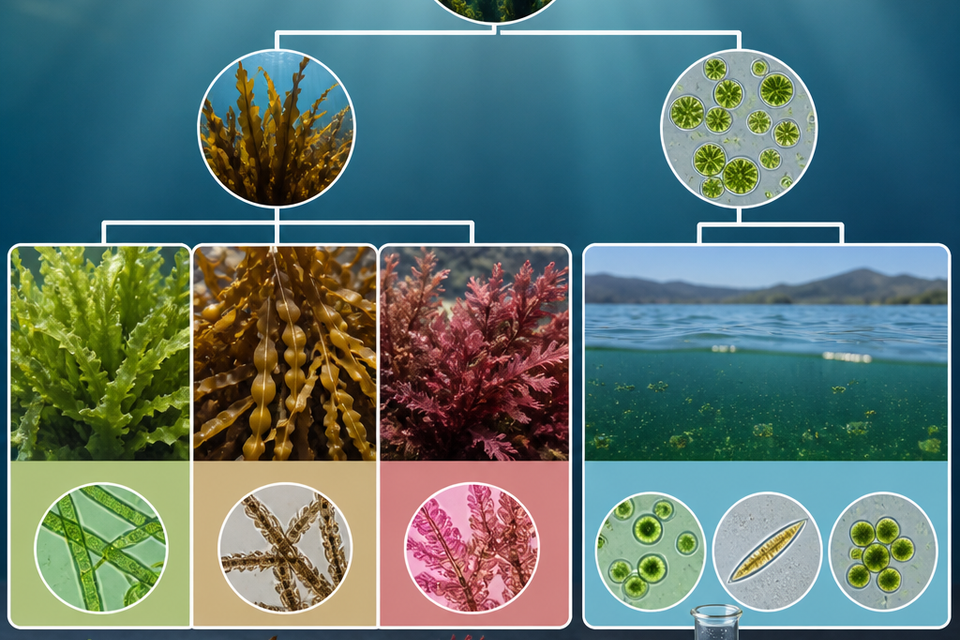
海藻是一个功能类群,而不是一个单一的科。主要类别主要通过色素来区分,色素决定了颜色、栖息地深度以及以下部分介绍的工业用途(食品、亲水胶体、饲料、生物燃料原料)。
海藻是生长在海水中的光合生物。它们分为两个实用组: 大型藻类,哪些是您可以看到的海藻,以及 微藻,其中包括浮游植物,通常在没有显微镜的情况下是看不见的。对于买家来说,团队决定原材料、供应路线和您编写的规格。
从条款开始
大多数混乱来自三个重叠的词:
- 海藻 是生活在咸水中的藻类的总称。
- 海藻 是大型藻类的日常名称。海藻是藻类的一种,不是一个单独的类别。
- 微藻 是单细胞或小型群体生物。浮游植物是在水体中漂浮的微藻。
如果供应商说“海藻”,请询问他们指的是哪一组。一个标有“海藻提取物”的规范和一个标有“微藻生物质”的规范描述了不同的材料,具有不同的采购和加工路径。
大型藻类:棕色、红色和绿色
大型藻类根据色素和细胞结构进行分类。这三个主要类别在颜色、储存的多糖以及生长地点方面有所不同。
- 褐藻 (褐藻纲)包括海带和残骸。它们的颜色来自掩盖叶绿素的色素。褐藻是海藻酸盐的主要商业来源,海藻酸盐具有增稠和稳定产品的作用。
- 红藻 (红藻门)包括以下物种 角叉菜属 和 江蓠属。它们的色素赋予它们微红色调,并且它们生长在许多深度。它们是卡拉胶和琼脂的常见来源。
- 绿藻 (绿藻门)包括海生菜(石莼属)。它们含有一定量的叶绿素,使它们看起来呈绿色。它们通常生长在潮间带,能够耐受不断变化的条件。
这些是一般差异。确切的组成随物种、季节和收获地点而变化,因此将组名称视为规范的起点,而不是内容的保证。
参观 海藻产品页面 看看这些群体如何出现在我们的范围内。
微藻和浮游植物:不同的生产模式
微藻遵循与海藻不同的路径。您不会从岩石中收获它们或在线种植它们。您在受控培养物中种植它们,然后将它们浓缩并与水分离。
生物学作用也不同。海洋微藻(浮游植物)是海水中主要的初级生产者。在公海,它们是初级生产的唯一来源,这意味着海洋食物网依赖于它们。对于买家来说,这比运营事实更重要:微藻路线依靠储罐、光源、营养物质和分离设备运行,而不是在收获季节运行。
有些人可能会认为微藻始终是更好的选择,因为它们生长得更快并且在受控条件下生长。但是,该优势取决于您的产品。种植成本、收获设备和目标化合物都会改变答案。
编写规范的实用方法
当您撰写海藻原材料请求时,请使用此订单:
- 为该组命名。 写下“棕色大型藻类”、“红色大型藻类”、“绿色大型藻类”或“微藻类”。单独避免“海藻”。
- 命名目标化合物或功能。 海藻酸盐、角叉菜胶、蛋白质或色素各自指向不同的组。
- 注明来源。 指定野生收获或栽培。这些路线具有不同的供应和一致性风险。
- 设置表格。 新鲜的、干燥的、粉末的或提取物每种都改变处理和成本。
- Ask for group-specific test data. Request compositional data for the group you named, not a generic "marine algae" certificate.
One example of a costly mix-up
Here is a common mistake, described as a hypothetical. A formulation team writes "marine algae powder" in a brief. The supplier ships a brown macroalgae powder, but the team needed a red algae material for a gelling function. The reformulation work then starts over. A group name in the spec prevents this.
Budget and risk notes
Pricing varies by group, source, and form, and we have no reliable figures to publish here for each group. Request quotes against a specific spec so the numbers compare the same material.
Also plan for risk. Some marine algae species produce toxins or harm fish, and blooms can affect both wild harvest and aquaculture water. For sourcing, ask suppliers how they monitor harvest areas and what they do when a bloom appears.
If you are unsure which group fits your product, 联系我们 with your target function and we can help you narrow the spec.
Why industrial buyers source marine algae as a raw material
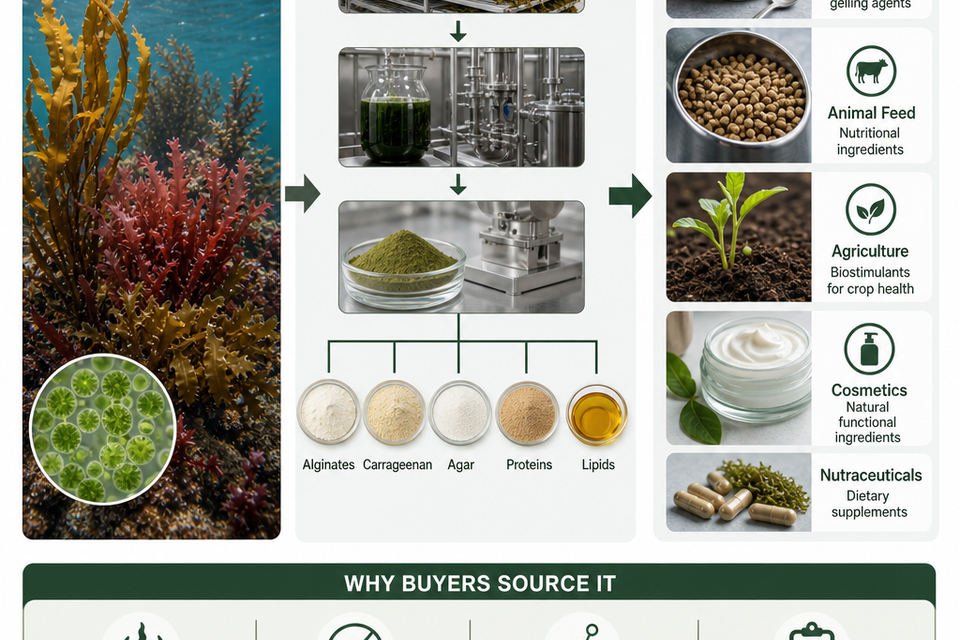
From ocean biomass to industrial ingredient: marine algae becomes valuable to B2B buyers because it is renewable, processable into consistent functional compounds such as alginates, carrageenan, and agar, and usable across multiple industrial sectors.
Industrial buyers source marine algae because it can supply a biomass input they can specify, test, and reorder. The deciding factor is not the algae's general appeal. It is whether every batch meets the same written specification. If a supplier cannot hold that spec, the material will fail in your process, no matter how well it looks on paper.
Marine algae are photosynthetic organisms that grow in seawater. For sourcing purposes, two broad groups matter: 大型藻类 (seaweeds, including brown, red, and green types) and 微藻 (phytoplankton). Dalcon Environmental notes that marine microalgae are the dominant primary producers in marine waters, and that marine fisheries depend on them. For a buyer, though, the more useful distinction is how each group is grown and harvested.
Where buyers evaluate algae as an input
Buyers usually test algae for a small set of uses: food and feed ingredients, personal care formulations, agricultural and aquaculture inputs, and materials still in early development. Each use sets its own specification, such as moisture, particle size, color, microbial limits, contaminant limits, and documentation.
Because these specs differ, a material that fits one use can fail another. Start by naming the use and writing down its limits before you request samples.
Three procurement drivers
Buyers typically reduce their reasons for sourcing to three questions:
- Consistency: Can the supplier hit the same spec on lot 1 and lot 20? Ask for the test methods and the acceptance range for each parameter.
- Supply continuity: Can the supplier deliver the same volume every quarter? Ask where the biomass comes from, how harvest timing is set, and what backup source exists.
- Formulation fit: Does the material run in your current process without changing mixing, drying, or dosing? Ask for samples and a bench trial before you change a recipe.
These questions turn a vague benefit claim into something you can check. A supplier that answers all three with data is easier to qualify than one that answers with marketing language.
The variability trade-off
Algae is a living input. Season, water temperature, nutrient levels, and harvest timing all change composition. The same species can differ from one harvest window to the next.
The cultivation model sets the trade-off between control and cost. Microalgae grown in controlled systems give more room to tighten specs. Macroalgae harvested from open water accept more natural variation. Before you choose a model, compare harvest cost, growth tim
Specification and sourcing checklist for procurement and R&D teams
A usable specification names the algae group, species, harvest method, form, and traceability, then requires lot-level documents to prove each one. Write these fields before you request quotes or run formulation trials. Without them, R&D tests one material and procurement buys another.
Why the spec must come first
Most sourcing problems start with vague words like "seaweed extract" or "marine algae powder." Those words cover brown, red, and green macroalgae and microalgae, which differ in structure, composition, and processing. A sample from one group does not predict the performance of another.
Write the spec before the supplier conversation. It gives both teams one shared definition, and it lets you compare quotes on the same basis.
The specification template
Use this table as a starting point. Fill every row, or mark it as an open question to resolve with the supplier.
| Field | What to write | 为什么这很重要 |
| 藻类群 | Brown, red, green, or microalgae/phytoplankton | Group drives the end use and the processing route |
| Species or genus | Scientific name, if known | Prevents substitution between look-alike materials |
| Harvest method | Wild harvest, cultivated, or other method the supplier uses | Affects consistency, traceability, and supply continuity |
| Form | Fresh, dried, powder, or extract | Changes handling, storage, dosing, and shelf life |
| 收获地点和季节 | Region and harvest window | Composition can shift with environment and season |
| Traceability | Lot numbering and the link from lot to harvest record | Lets you trace a problem back to its source |
| Acceptance range | A min-max range for key attributes your team sets | Turns "good enough" into a checkable test |
| Yield basis | How the supplier calculates yield, and the moisture or dry-weight basis | Prevents comparing quotes that use different bases |
| Lead time | Order-to-delivery time, stated by the supplier | Sets the minimum stock buffer you need |
Specify ranges, not single values. A single target value makes normal lot variation look like a failure.
Questions to ask suppliers
Send these questions in writing. Written answers give you a record to compare later.
- Where is the material harvested, and can you name the region?
- In which months is it harvested, and how do you handle off-season supply?
- What harvest method do you use, and how does it change between lots?
- Can you link each lot number to its harvest record?
- Which lot-level documents do you issue with each shipment?
- What yield figure do you quote, and on what moisture or dry-weight basis?
- What is your standard lead time, and what causes it to slip?
Some suppliers will answer all seven clearly. Others will not. A vague answer to questions 4 and 5 is a warning sign on its own.
Documents to request
Ask every supplier for the documents that cover your specification. Confirm with your regulatory team which standards apply in your target market before you accept any document as sufficient. Common requests include:
- Certificate of analysis for each lot, with results against your acceptance ranges
- Lot traceability record linking the lot to harvest location, date, and method
- Species confirmation or identification record for the material
- Processing record for dried, powdered, or extracted forms
Do not treat a document as proof of quality until your team has checked that it covers the attributes in your spec.
A practical example
Suppose R&D validates a formulation using a sample from one harvest window. Procurement then buys a production lot from a different season, and the lot's composition falls outside the range R&D tested.
The spec would have caught this if it had included a harvest season field and an acceptance range. The fix is simple: require at least three consecutive production lots to fall within your acceptance range before you lock the spec. If lot-to-lot variation exceeds your range, re-test the formulation or tighten the spec before you commit volume.
Some teams argue that a broad spec gives them more supplier options. That holds only for early trials. For production, a broad spec shifts risk onto your formulation, so narrow the spec once trials show which attributes matter.
Budget and implementation risks
Budget context is unclear until you have real quotes. Do not estimate costs from general assumptions. Request quotes against the same spec, with the same yield basis and lead time, so you can compare them directly.
Watch for these implementation risks:
- Species drift: the supplier changes source or species without notice.
- Seasonal gaps: the material is unavailable in certain months, which forces an unplanned switch.
- Documentation gaps: lots ship without the records your spec requires.
- Re-qualification time: a supplier or source change can force new R&D trials, which add time before production.
Build a re-qualification step into your supplier change process. Treat any change in source, species, or form as a new spec event.
Next steps
Start with the 海藻产品页面 to see which forms and groups are covered. Then use the 联系我们页面 to send your completed template for a specification review. If you are still defining a new input, the new raw material development page and the 关于我们页面 explain how the team works with buyers and R&D.
Common buyer pain points and open questions
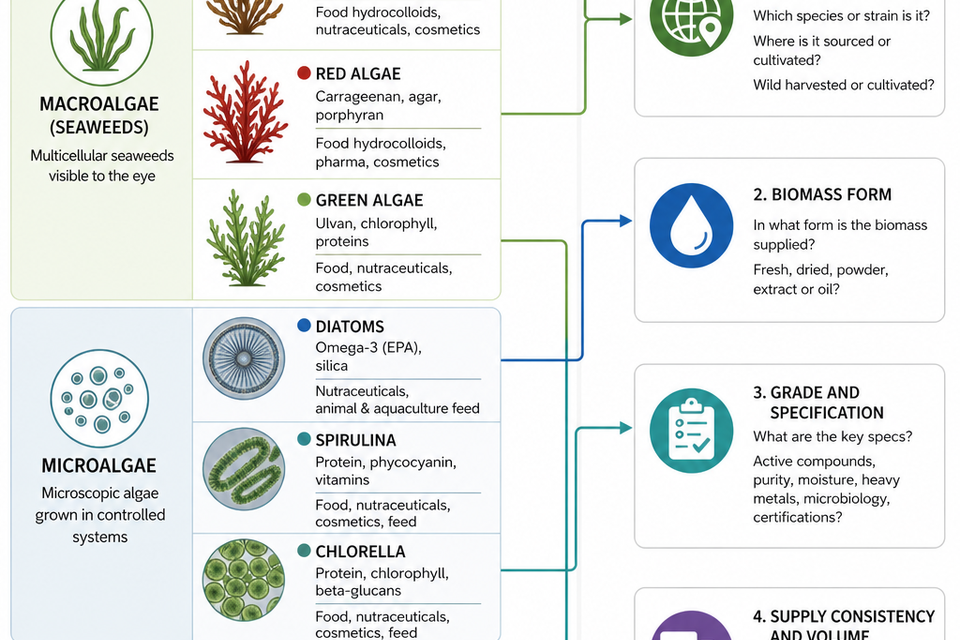
Marine algae is an umbrella term covering very different organisms with different compounds and supply chains. Before sourcing, confirm which group, species, and biomass form your application requires, since these determine specifications, pricing, and supplier fit.
Buyers most often get stuck on three things: batch-to-batch consistency, unclear origin data, and unclear cost per usable unit. You can check all three before you commit to a trial.
Editor note: No forum threads or community discussions were supplied for this section, so the pain points below are framed as common buyer questions. Each needs a cited source before publication.
Pain point 1: One batch performs differently from the next
Marine algae are biological materials. Composition shifts with species, harvest timing, and water conditions. A strong sample tells you little about the lot that arrives six months later.
Ask for a lot-level certificate of analysis with every shipment. Compare at least three consecutive lots before you scale up.
Pain point 2: Origin data is vague
"Marine algae" covers brown, red, and green macroalgae, plus microalgae (phytoplankton). These groups differ in how they grow, how they are harvested, and how long they take to reach harvest size. Wild-harvested and cultivated material can also look similar on a spec sheet.
Treat an origin question as a production-model question. Ask:
- Is the material wild-harvested or cultivated?
- If cultivated, is it open-ocean or land-based?
- Where and when was this lot harvested?
Pain point 3: Cost per usable unit is hard to compare
Quotes often list price per kilogram of wet or dried biomass. That number hides yield. If Supplier B costs 20% more per kilogram but delivers 25% more of the active material you need, B is the cheaper option.
Convert every quote to cost per kilogram of usable material. Then compare quotes on the same basis.
Pain point 4: Implementation risks get little attention
Buyers rarely ask how a supplier handles contamination or toxic blooms. For aquaculture and seafood operators, this matters because some species produce toxins or harm fish. Ask suppliers:
- Which contaminants and species do they test for?
- What happens to a lot that fails testing?
- How do they notify customers about a problem lot?
How to verify claims before a trial
- Request the species name (Latin binomial) and the lot certificate.
- Ask for harvest site, date, and production method.
- Write a spec for the properties you need and agree on test methods upfront.
- Run a small trial and keep retained samples from each lot.
- Test at least three lots before you commit to volume.
Where evidence is still thin
Published comparisons of yield, harvest cost, and scalability across production models are limited in the sources reviewed for this section. Do not treat any supplier's yield or cost claim as settled until they provide their own data. Ask for the test method behind each number.
For a broader view of the material types, visit our 海藻 page. If you need help matching a spec to a raw material, see our page on 新原料开发. For company background, read our about us page. For technical questions about your application, 联系我们.
结论
Marine algae are a broad category, so the first step is knowing which group you're actually dealing with. Macroalgae, microalgae, and phytoplankton behave differently in cultivation, harvesting, and specification, and mixing them up is one of the fastest ways to end up with the wrong inputs. From there, most sourcing decisions come down to specifications you can verify: the algae group, form, harvest method, traceability, and lot-level documentation. Natural variability is real, so build your specs and testing plan around it rather than hoping it won't show up.
If you're at the stage of comparing inputs, start by writing down your specification fields using the checklist above, then review the marine algae product page to see how the options line up. If you have technical questions or want to request specifications for a trial, reach out through our contact page. You can also look at our new raw material development page if you're evaluating an input that isn't yet in your standard range.
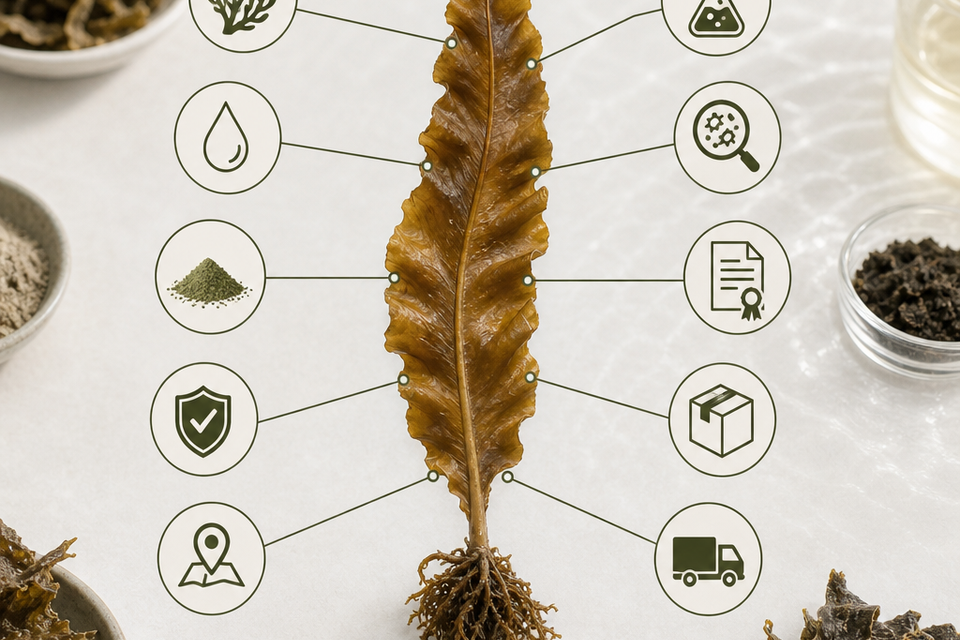
Use this checklist to define marine algae specifications before supplier qualification. Items marked as must-verify, such as species identity, contaminant limits, and Certificates of Analysis, should be confirmed in writing for every lot, because differences in form, origin, or processing can change both functional performance and regulatory compliance.