Jos etsit "mikä on merilevä", yrität todennäköisesti selvittää, sopiiko tämä raaka-aine kehittämääsi tuotteeseen tai formulaatioon ja mitä sinun on kysyttävä toimittajalta ennen kuin jatkat. Lyhyesti sanottuna merilevät ovat fotosynteettisiä organismeja, jotka elävät meriympäristöissä. Ne jakautuvat kahteen laajaan ryhmään: makroleviin, jotka ovat useimpien ihmisten kuvittelemia merileviä, ja mikroleviin, jotka sisältävät kasviplanktonia ja ovat aivan liian pieniä nähdäkseen ilman mikroskooppia. Teollisuusostajat hankkivat ne raaka-aineena, kun he tarvitsevat panoksen, jonka he voivat määrittää, testata ja hankkia luotettavasti ajan mittaan.
Tämä opas kattaa perusasiat käytännön järjestyksessä. Aloitamme siitä, kuinka merilevät luokitellaan ja missä yleiset termit, kuten "merilevä" ja "mikrolevät", sekoittuvat. Seuraavaksi tarkastelemme, miksi teolliset ostajat arvioivat levät panoksena ja niiden painottamia kompromisseja, erityisesti luonnollista vaihtelua verrattuna vakaisiin spesifikaatioihin. Sitten annamme sinulle hankinta- ja T&K-tiimien määrittelyn ja hankinnan tarkistuslistan ja lopuksi ostajien usein esittämiin kysymyksiin, joissa todisteet ovat vielä heikkoja.
Mitä merilevät ovat: luokitus ja pääryhmät
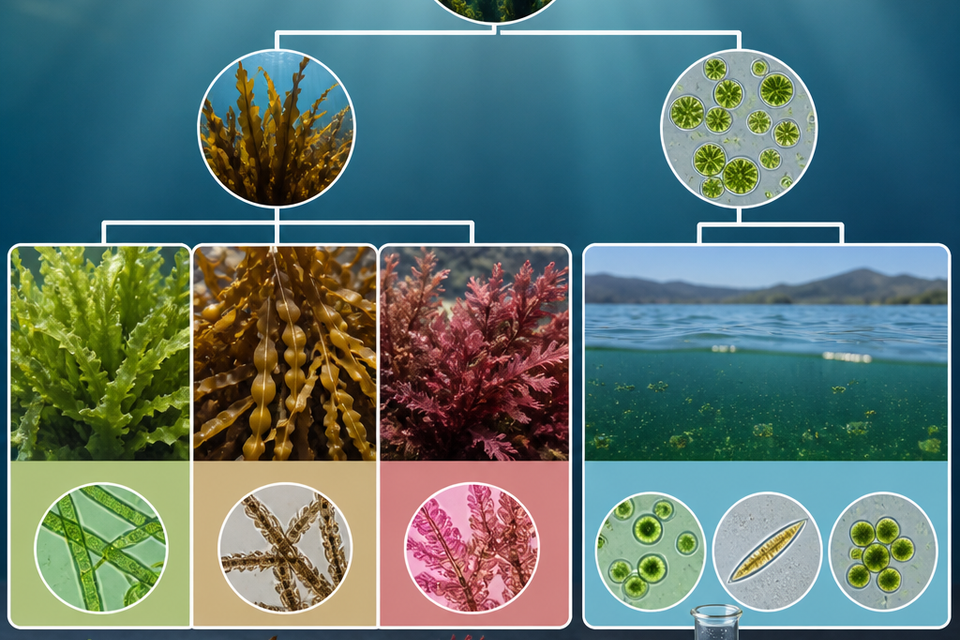
Merilevä on toiminnallinen ryhmä, ei yksittäinen perhe. Tärkeimmät ryhmät erotetaan pääasiassa pigmentin perusteella, joka määrää värin, elinympäristön syvyyden ja seuraavissa kohdissa käsitellyt teolliset käyttötarkoitukset (elintarvikkeet, hydrokolloidit, rehu, biopolttoaineen raaka-aine).
Merilevät ovat fotosynteettisiä organismeja, jotka kasvavat merivedessä. Ne jaetaan kahteen käytännön ryhmään: makrolevät, jotka ovat merileviä, joita näet, ja mikrolevät, jotka sisältävät kasviplanktonia ja ovat yleensä näkymättömiä ilman mikroskooppia. Ostajalle ryhmä päättää raaka-aineen, toimitusreitin ja kirjoittamasi tekniset tiedot.
Aloita ehdoista
Suurin osa hämmennystä syntyy kolmesta päällekkäisestä sanasta:
- Meren levät on kattotermi suolaisessa vedessä eläville leville.
- Merilevä on makrolevien arkipäiväinen nimi. Merilevä on eräänlainen levä, ei erillinen luokka.
- Mikrolevät ovat yksisoluisia tai pieniä siirtomaaorganismeja. Kasviplanktoni on vesipatsassa ajelehtivia mikroleviä.
Jos toimittaja sanoo "merilevät", kysy mitä ryhmää he tarkoittavat. Tekniset tiedot, joissa lukee "merileväuute" ja "mikrolevien biomassa", kuvaavat erilaisia materiaaleja, joilla on erilaiset hankinta- ja käsittelyreitit.
Makrolevät: ruskea, punainen ja vihreä
Makrolevät luokitellaan pigmentin ja solurakenteen mukaan. Kolme pääryhmää eroavat toisistaan värin, varastoimien polysakkaridien ja kasvupaikan suhteen.
- Ruskeat levät (Phaeophyceae) ovat rakkolevä ja rakka. Niiden väri tulee pigmenteistä, jotka peittävät klorofyllin. Ruskeat levät ovat tärkein kaupallinen alginaattien lähde, joka sakeuttaa ja stabiloi tuotteita.
- Punaiset levät (Rhodophyta) sisältävät lajit, kuten Chondrus ja Gracilaria. Niiden pigmentit antavat niille punertavan sävyn, ja ne kasvavat monissa syvyyksissä. Ne ovat tavallinen karrageenin ja agarin lähde.
- Vihreät levät (Chlorophyta) sisältää merisalaattia (Ulva). Ne sisältävät klorofylliä sellaisia määriä, että ne näyttävät vihreiltä. Ne kasvavat usein vuorovesivyöhykkeellä, missä ne sietävät muuttuvia olosuhteita.
Nämä ovat yleisiä eroja. Tarkka koostumus muuttuu lajin, vuodenajan ja sadonkorjuun mukaan, joten pidä ryhmien nimiä määrittelyn lähtökohtana, ei sisällön takuina.
Vieraile osoitteessa merilevätuotesivu nähdäksesi, miten nämä ryhmät näkyvät valikoimassamme.
Mikrolevät ja kasviplankton: erilainen tuotantomalli
Mikrolevät kulkevat eri polkua kuin merilevä. Et kerää niitä kivistä tai viljele niitä siimalla. Kasvatat niitä kontrolloidussa viljelmässä, sitten keskität ja erotat ne vedestä.
Myös biologinen rooli vaihtelee. Meren mikrolevät (kasviplanktoni) ovat merivesien hallitsevia alkutuottajia. Avomerellä ne ovat ainoa alkutuotannon lähde, mikä tarkoittaa, että meren ravintoverkostot ovat niistä riippuvaisia. Ostajalle tällä on vähemmän merkitystä kuin toiminnallisella tosiasialla: mikroleväreitti kulkee säiliöissä, valossa, ravintoaineissa ja erotuslaitteissa, ei sadonkorjuukaudella.
Jotkut saattavat väittää, että mikrolevät ovat aina parempi vaihtoehto, koska ne kasvavat nopeammin ja kontrolloiduissa olosuhteissa. Tämä etu riippuu kuitenkin tuotteestasi. Viljelykustannukset, sadonkorjuulaitteet ja kohdeyhdisteet muuttavat vastauksen.
Käytännöllinen tapa kirjoittaa tiedot
Käytä tätä järjestystä, kun kirjoitat merilevän raaka-ainetta:
- Nimeä ryhmä. Kirjoita "ruskeat makrolevät", "punaiset makrolevät", "vihreät makrolevät" tai "mikrolevät". Vältä "merilevää" yksinään.
- Nimeä kohdeyhdiste tai funktio. Alginaatti, karrageeni, proteiini tai pigmentti viittaavat kukin eri ryhmiin.
- State the source. Specify wild-harvested or cultivated. These routes carry different supply and consistency risks.
- Set the form. Fresh, dried, powder, or extract each change handling and cost.
- Ask for group-specific test data. Request compositional data for the group you named, not a generic "marine algae" certificate.
One example of a costly mix-up
Here is a common mistake, described as a hypothetical. A formulation team writes "marine algae powder" in a brief. The supplier ships a brown macroalgae powder, but the team needed a red algae material for a gelling function. The reformulation work then starts over. A group name in the spec prevents this.
Budget and risk notes
Pricing varies by group, source, and form, and we have no reliable figures to publish here for each group. Request quotes against a specific spec so the numbers compare the same material.
Also plan for risk. Some marine algae species produce toxins or harm fish, and blooms can affect both wild harvest and aquaculture water. For sourcing, ask suppliers how they monitor harvest areas and what they do when a bloom appears.
If you are unsure which group fits your product, ota meihin yhteyttä with your target function and we can help you narrow the spec.
Why industrial buyers source marine algae as a raw material
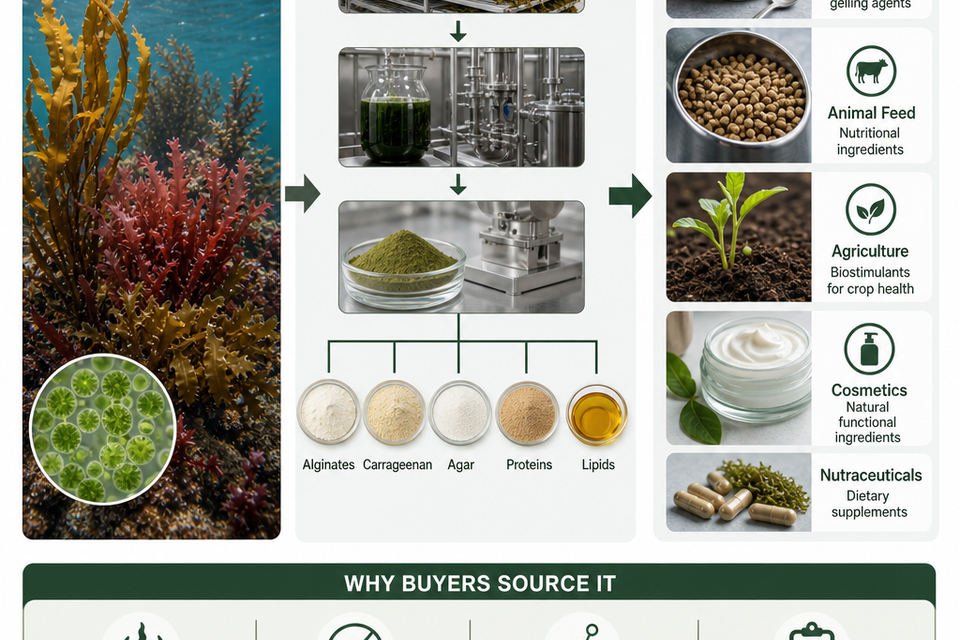
From ocean biomass to industrial ingredient: marine algae becomes valuable to B2B buyers because it is renewable, processable into consistent functional compounds such as alginates, carrageenan, and agar, and usable across multiple industrial sectors.
Industrial buyers source marine algae because it can supply a biomass input they can specify, test, and reorder. The deciding factor is not the algae's general appeal. It is whether every batch meets the same written specification. If a supplier cannot hold that spec, the material will fail in your process, no matter how well it looks on paper.
Marine algae are photosynthetic organisms that grow in seawater. For sourcing purposes, two broad groups matter: makrolevät (seaweeds, including brown, red, and green types) and mikrolevät (phytoplankton). Dalcon Environmental notes that marine microalgae are the dominant primary producers in marine waters, and that marine fisheries depend on them. For a buyer, though, the more useful distinction is how each group is grown and harvested.
Where buyers evaluate algae as an input
Buyers usually test algae for a small set of uses: food and feed ingredients, personal care formulations, agricultural and aquaculture inputs, and materials still in early development. Each use sets its own specification, such as moisture, particle size, color, microbial limits, contaminant limits, and documentation.
Because these specs differ, a material that fits one use can fail another. Start by naming the use and writing down its limits before you request samples.
Three procurement drivers
Buyers typically reduce their reasons for sourcing to three questions:
- Consistency: Can the supplier hit the same spec on lot 1 and lot 20? Ask for the test methods and the acceptance range for each parameter.
- Supply continuity: Can the supplier deliver the same volume every quarter? Ask where the biomass comes from, how harvest timing is set, and what backup source exists.
- Formulation fit: Does the material run in your current process without changing mixing, drying, or dosing? Ask for samples and a bench trial before you change a recipe.
These questions turn a vague benefit claim into something you can check. A supplier that answers all three with data is easier to qualify than one that answers with marketing language.
The variability trade-off
Algae is a living input. Season, water temperature, nutrient levels, and harvest timing all change composition. The same species can differ from one harvest window to the next.
The cultivation model sets the trade-off between control and cost. Microalgae grown in controlled systems give more room to tighten specs. Macroalgae harvested from open water accept more natural variation. Before you choose a model, compare harvest cost, growth tim
Specification and sourcing checklist for procurement and R&D teams
A usable specification names the algae group, species, harvest method, form, and traceability, then requires lot-level documents to prove each one. Write these fields before you request quotes or run formulation trials. Without them, R&D tests one material and procurement buys another.
Why the spec must come first
Most sourcing problems start with vague words like "seaweed extract" or "marine algae powder." Those words cover brown, red, and green macroalgae and microalgae, which differ in structure, composition, and processing. A sample from one group does not predict the performance of another.
Write the spec before the supplier conversation. It gives both teams one shared definition, and it lets you compare quotes on the same basis.
The specification template
Use this table as a starting point. Fill every row, or mark it as an open question to resolve with the supplier.
| Field | What to write | Miksi sillä on merkitystä |
| Leväryhmä | Brown, red, green, or microalgae/phytoplankton | Group drives the end use and the processing route |
| Species or genus | Scientific name, if known | Prevents substitution between look-alike materials |
| Harvest method | Wild harvest, cultivated, or other method the supplier uses | Affects consistency, traceability, and supply continuity |
| Form | Fresh, dried, powder, or extract | Changes handling, storage, dosing, and shelf life |
| Sadonkorjuupaikka ja kausi | Region and harvest window | Composition can shift with environment and season |
| Traceability | Lot numbering and the link from lot to harvest record | Lets you trace a problem back to its source |
| Acceptance range | A min-max range for key attributes your team sets | Turns "good enough" into a checkable test |
| Yield basis | How the supplier calculates yield, and the moisture or dry-weight basis | Prevents comparing quotes that use different bases |
| Lead time | Order-to-delivery time, stated by the supplier | Sets the minimum stock buffer you need |
Specify ranges, not single values. A single target value makes normal lot variation look like a failure.
Questions to ask suppliers
Send these questions in writing. Written answers give you a record to compare later.
- Where is the material harvested, and can you name the region?
- In which months is it harvested, and how do you handle off-season supply?
- What harvest method do you use, and how does it change between lots?
- Can you link each lot number to its harvest record?
- Which lot-level documents do you issue with each shipment?
- What yield figure do you quote, and on what moisture or dry-weight basis?
- What is your standard lead time, and what causes it to slip?
Some suppliers will answer all seven clearly. Others will not. A vague answer to questions 4 and 5 is a warning sign on its own.
Documents to request
Ask every supplier for the documents that cover your specification. Confirm with your regulatory team which standards apply in your target market before you accept any document as sufficient. Common requests include:
- Certificate of analysis for each lot, with results against your acceptance ranges
- Lot traceability record linking the lot to harvest location, date, and method
- Species confirmation or identification record for the material
- Processing record for dried, powdered, or extracted forms
Do not treat a document as proof of quality until your team has checked that it covers the attributes in your spec.
A practical example
Suppose R&D validates a formulation using a sample from one harvest window. Procurement then buys a production lot from a different season, and the lot's composition falls outside the range R&D tested.
The spec would have caught this if it had included a harvest season field and an acceptance range. The fix is simple: require at least three consecutive production lots to fall within your acceptance range before you lock the spec. If lot-to-lot variation exceeds your range, re-test the formulation or tighten the spec before you commit volume.
Some teams argue that a broad spec gives them more supplier options. That holds only for early trials. For production, a broad spec shifts risk onto your formulation, so narrow the spec once trials show which attributes matter.
Budget and implementation risks
Budget context is unclear until you have real quotes. Do not estimate costs from general assumptions. Request quotes against the same spec, with the same yield basis and lead time, so you can compare them directly.
Watch for these implementation risks:
- Species drift: the supplier changes source or species without notice.
- Seasonal gaps: the material is unavailable in certain months, which forces an unplanned switch.
- Documentation gaps: lots ship without the records your spec requires.
- Re-qualification time: a supplier or source change can force new R&D trials, which add time before production.
Build a re-qualification step into your supplier change process. Treat any change in source, species, or form as a new spec event.
Next steps
Start with the merilevätuotesivu to see which forms and groups are covered. Then use the ota meihin yhteyttä -sivu to send your completed template for a specification review. If you are still defining a new input, the new raw material development page and the sivu meistä explain how the team works with buyers and R&D.
Common buyer pain points and open questions
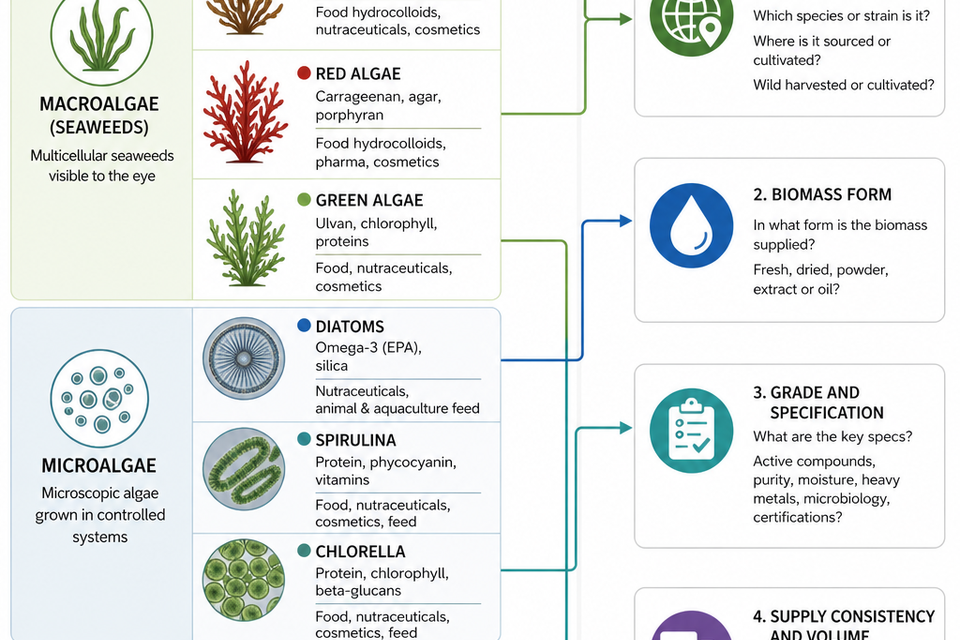
Marine algae is an umbrella term covering very different organisms with different compounds and supply chains. Before sourcing, confirm which group, species, and biomass form your application requires, since these determine specifications, pricing, and supplier fit.
Buyers most often get stuck on three things: batch-to-batch consistency, unclear origin data, and unclear cost per usable unit. You can check all three before you commit to a trial.
Editor note: No forum threads or community discussions were supplied for this section, so the pain points below are framed as common buyer questions. Each needs a cited source before publication.
Pain point 1: One batch performs differently from the next
Marine algae are biological materials. Composition shifts with species, harvest timing, and water conditions. A strong sample tells you little about the lot that arrives six months later.
Ask for a lot-level certificate of analysis with every shipment. Compare at least three consecutive lots before you scale up.
Pain point 2: Origin data is vague
"Marine algae" covers brown, red, and green macroalgae, plus microalgae (phytoplankton). These groups differ in how they grow, how they are harvested, and how long they take to reach harvest size. Wild-harvested and cultivated material can also look similar on a spec sheet.
Treat an origin question as a production-model question. Ask:
- Is the material wild-harvested or cultivated?
- If cultivated, is it open-ocean or land-based?
- Where and when was this lot harvested?
Pain point 3: Cost per usable unit is hard to compare
Quotes often list price per kilogram of wet or dried biomass. That number hides yield. If Supplier B costs 20% more per kilogram but delivers 25% more of the active material you need, B is the cheaper option.
Convert every quote to cost per kilogram of usable material. Then compare quotes on the same basis.
Pain point 4: Implementation risks get little attention
Buyers rarely ask how a supplier handles contamination or toxic blooms. For aquaculture and seafood operators, this matters because some species produce toxins or harm fish. Ask suppliers:
- Which contaminants and species do they test for?
- What happens to a lot that fails testing?
- How do they notify customers about a problem lot?
How to verify claims before a trial
- Request the species name (Latin binomial) and the lot certificate.
- Ask for harvest site, date, and production method.
- Write a spec for the properties you need and agree on test methods upfront.
- Run a small trial and keep retained samples from each lot.
- Test at least three lots before you commit to volume.
Where evidence is still thin
Published comparisons of yield, harvest cost, and scalability across production models are limited in the sources reviewed for this section. Do not treat any supplier's yield or cost claim as settled until they provide their own data. Ask for the test method behind each number.
For a broader view of the material types, visit our merilevät page. If you need help matching a spec to a raw material, see our page on uusien raaka-aineiden kehittämiseen. For company background, read our about us page. For technical questions about your application, ota meihin yhteyttä.
Johtopäätös
Marine algae are a broad category, so the first step is knowing which group you're actually dealing with. Macroalgae, microalgae, and phytoplankton behave differently in cultivation, harvesting, and specification, and mixing them up is one of the fastest ways to end up with the wrong inputs. From there, most sourcing decisions come down to specifications you can verify: the algae group, form, harvest method, traceability, and lot-level documentation. Natural variability is real, so build your specs and testing plan around it rather than hoping it won't show up.
If you're at the stage of comparing inputs, start by writing down your specification fields using the checklist above, then review the marine algae product page to see how the options line up. If you have technical questions or want to request specifications for a trial, reach out through our contact page. You can also look at our new raw material development page if you're evaluating an input that isn't yet in your standard range.
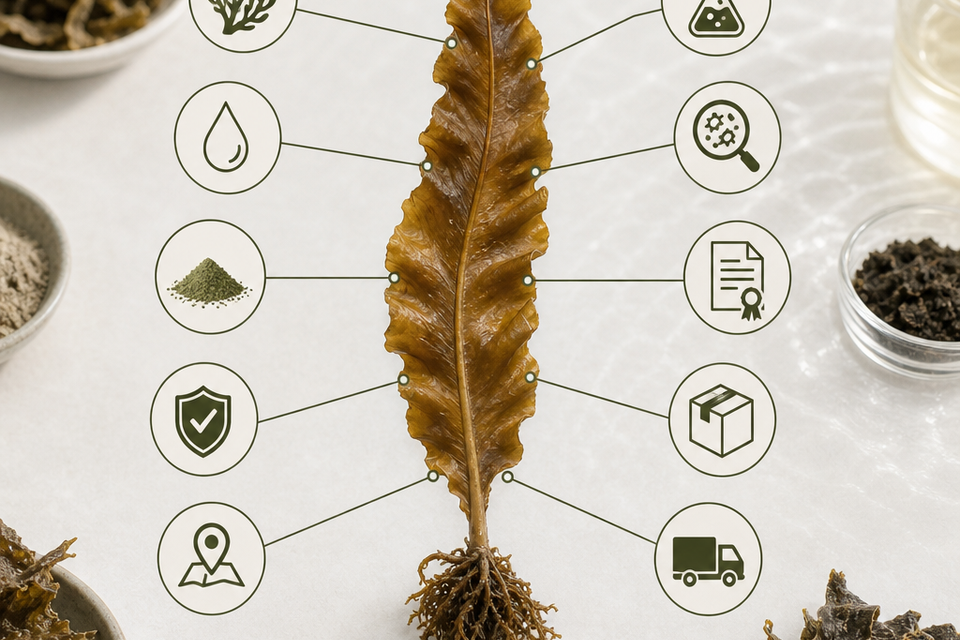
Use this checklist to define marine algae specifications before supplier qualification. Items marked as must-verify, such as species identity, contaminant limits, and Certificates of Analysis, should be confirmed in writing for every lot, because differences in form, origin, or processing can change both functional performance and regulatory compliance.