Sè vo circate di "chì hè l'alga marina", probabilmente pruvate à sapè se sta materia prima si adatta à un pruduttu o una formulazione chì avete sviluppatu, è ciò chì avete bisognu di dumandà à un fornitore prima di andà più. In corta, l'alga marina sò organismi fotosintesi chì campanu in ambienti marini. Ci sò dui gruppi larghi: macroalgae, chì sò l'alga chì a maiò parte di a ghjente imagine, è microalgae, chì include u fitoplancton è sò troppu chjuchi per vede senza un microscopiu. I cumpratori industriali li fontanu cum'è una materia prima quandu anu bisognu di un input chì ponu specificà, pruvà è surghjente in modu affidabile in u tempu.
Questa guida copre i principii in un ordine praticu. Cuminciamu cù cumu l'alga marina sò classificate è induve i termini cumuni cum'è "alga" è "microalga" sò cunfunditi. Dopu, fighjemu perchè i cumpratori industriali valutanu l'alga cum'è un input è i cummerci chì pesanu, in particulare a variabilità naturali versus specificazioni stabili. Allora vi damu una specificazione è una lista di cuntrollu di l'approvvigionamentu per e squadre di acquisti è R&D, è finisce cù e dumande chì i cumpratori spessu ponenu è induve l'evidenza hè sempre magre.
Chì sò l'alga marina: classificazione è gruppi principali
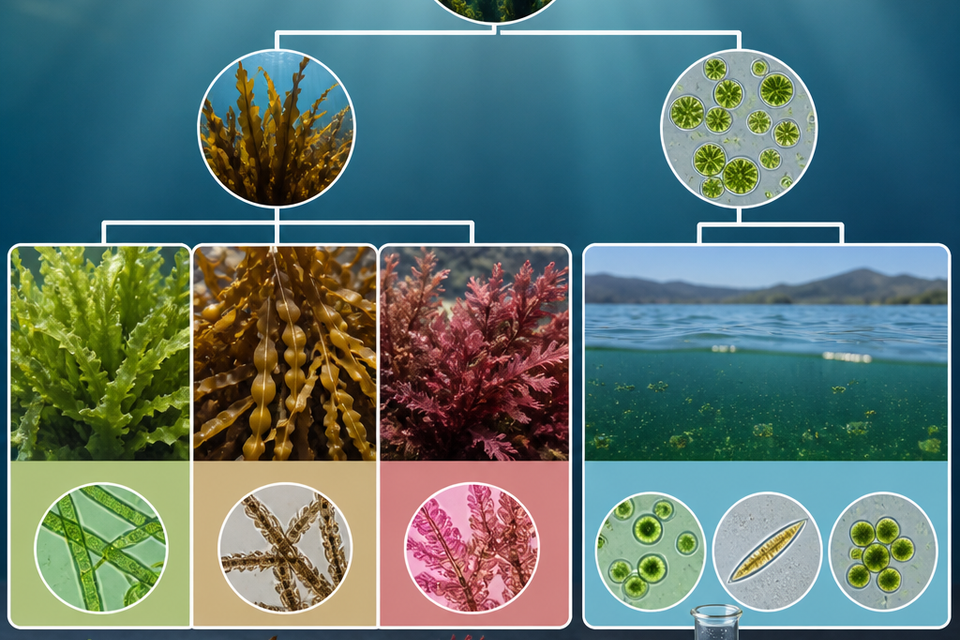
L'alga marina hè un gruppu funziunale, micca una sola famiglia. I gruppi maiò sò distinti principarmenti da u pigmentu, chì determina u culore, a prufundità di l'habitat, è l'usi industriali (alimentari, idrocolloidi, mangimi, biocarburanti) coperti in e seguenti sezzioni.
L'alga marina sò organismi fotosintesi chì crescenu in l'acqua di mare. Ci sò dui gruppi pratichi: macroalga, chì sò l'alghe chì pudete vede, è microalga, chì include u fitoplancton è sò generalmente invisibili senza un microscopiu. Per un cumpratore, u gruppu decide a materia prima, a strada di furnimentu, è a spec chì scrive.
Cumincià cù i termini
A maiò parte di a cunfusione vene da trè parolle sovrapposte:
- Alga marina hè u termu umbrella per l'alga chì campanu in acqua salata.
- Alga hè u nome di ogni ghjornu per macroalgae. L'alga hè un tipu d'alga, micca una categuria separata.
- Microalga sò organismi unicellulari o picculi culuniali. U fitoplancton hè a microalga chì si move in a colonna d'acqua.
Se un fornitore dice "alga marina", dumandate à quale gruppu significanu. Una spec chì dice "estratto d'alga" è una spec chì dice "biomassa di microalga" descrizanu diversi materiali, cù diversi camini d'approvvigionamento è di trasfurmazioni.
Macroalgae: marroni, rossi è verdi
Macroalgae sò classificate per pigmentu è struttura cellulare. I trè gruppi principali sò diffirenti in u culore, i polisaccharidi chì anu guardatu, è induve crescenu.
- Alga marrone (Phaeophyceae) include kelp è wracks. U so culore vene da i pigmenti chì mascheranu a clorofilla. L'alga marroni sò a principale fonte cummerciale di alginati, chì addensanu è stabilizzanu i prudutti.
- Alga rossa (Rhodophyta) includenu spezie cum'è Chondrus è Gracilaria. I so pigmenti li dà un tonu rossu, è crescenu in assai prufundità. Sò a fonte abituale di carragenina è agar.
- Alga verde (Chlorophyta) include lattuga di mare (Ulva). Contenenu clorofilla in quantità chì li facenu vede verdi. Spessu crescenu in a zona intertidal, induve toleranu e cundizioni cambianti.
Quessi sò differenzi generale. A cumpusizioni esatta cambia cù spezie, stagione è locu di cugliera, cusì trattate i nomi di u gruppu cum'è un puntu di partenza per a specificazione, micca una guaranzia di cuntenutu.
Visita u pagina di prudutti d'alga marina per vede cumu questi gruppi appariscenu in a nostra gamma.
Microalgae è fitoplancton: un mudellu di pruduzzione sfarente
A microalga segue una strada diversa da l'alga. Ùn li coglie micca da e rocce o cultivate nantu à e linee. I cresce in una cultura cuntrullata, poi cuncentrate è separà da l'acqua.
U rolu biologicu hè ancu diversu. U microalga marina (fitoplancton) sò i pruduttori primari dominanti in l'acque marine. In l'oceanu apertu, sò l'unica fonte di produzzione primaria, chì significa chì e rete alimentaria marini dependenu di elli. Per un cumpratore, questu importa menu di u fattu operativu: a strada di microalgae corre nantu à i tanki, luce, nutrienti è equipaggiu di separazione, micca in una stagione di cugliera.
Qualchidunu puderia argumentà chì e microalga sò sempre l'opzione megliu perchè crescenu più veloce è in cundizioni cuntrullate. Tuttavia, stu vantaghju dipende di u vostru pruduttu. I costi di cultivazioni, l'equipaggiu di cugliera è i cumposti di destinazione cambianu a risposta.
Un modu praticu per scrive a spec
Aduprate questu ordine quandu scrivite una dumanda per una materia prima d'alga marina:
- Nome u gruppu. Scrivite "macroalga marrone", "macroalga rossa", "macroalga verde" o "microalga". Evite solu "alga".
- Nome u cumpostu o funzione di destinazione. Alginate, carrageenan, proteina, o pigmentu ogni puntu à diversi gruppi.
- State a fonte. Specificà a cugliera salvatica o cultivata. Queste rotte portanu diversi risichi di fornitura è cunsistenza.
- Pone a forma. Fresche, secche, polverate, o estratti ogni cambiamentu di manipulazione è costu.
- Richiede dati di teste specifichi di u gruppu. Richiede dati di cumpusizioni per u gruppu chjamatu, micca un certificatu genericu "alga marina".
Un esempiu di una mischia costosa
Eccu un sbagliu cumuni, chjamatu cum'è ipoteticu. Un squadra di formulazione scrive "polvere d'alga marina" in un brevi. U fornitore spedisce un polveru di macroalga marrone, ma a squadra avia bisognu di un materiale d'alga rossa per una funzione di gelificazione. Allora u travagliu di riformulazione ricomincia. Un nome di gruppu in u spec impedisce questu.
Note di bilanciu è di risicu
U prezzu varieghja per gruppu, fonte è forma, è ùn avemu micca figuri affidabili per publicà quì per ogni gruppu. Richiede quotazioni contr'à una specifica specifica per chì i numeri paragunanu u listessu materiale.
Pianu ancu per risicu. Certi spezii d'alga marina pruducia tossine o dannu i pesci, è i fiori ponu influenzà a cugliera salvatica è l'acqua di l'acquacultura. Per l'approvvigionamentu, dumandate à i fornituri cumu monitoranu e zone di cugliera è ciò chì facenu quandu una fioritura appare.
Se ùn site micca sicuru chì gruppu si adatta à u vostru pruduttu, cuntattateci cù a vostra funzione di destinazione è pudemu aiutà vi ristrette a spec.
Perchè i cumpratori industriali fontanu alga marina cum'è materia prima
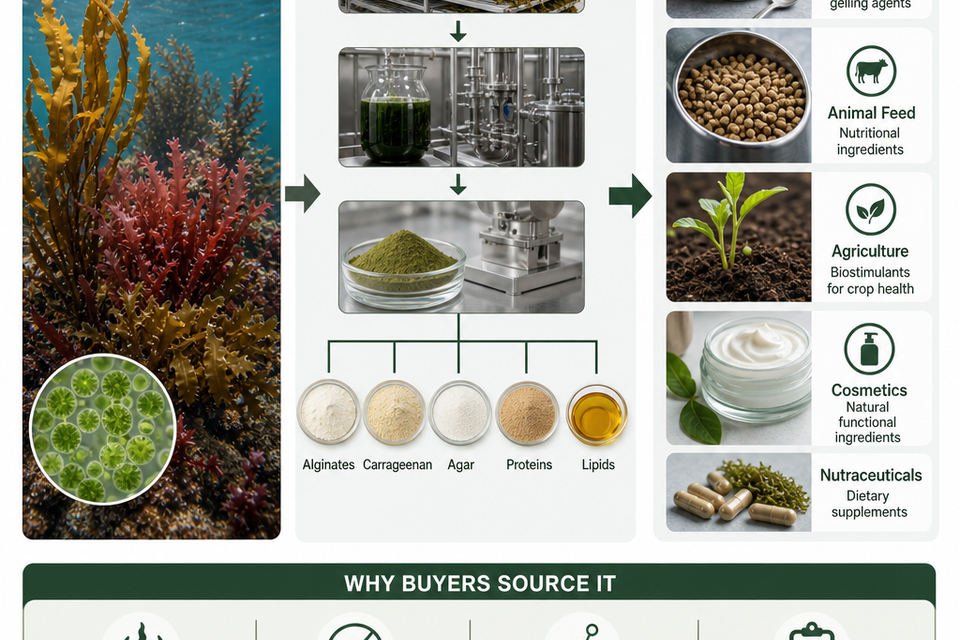
Da a biomassa di l'oceanu à l'ingredientu industriale: l'alga marina diventa preziosa per i cumpratori B2B perchè hè rinnuvevule, processable in composti funzionali coerenti cum'è alginati, carragenina è agar, è utilizzabile in parechji settori industriali.
I cumpratori industriali fontanu alghe marine perchè ponu furnisce un input di biomassa chì ponu specificà, testà è riordinà. U fattore decisivu ùn hè micca l'appellu generale di l'alga. Hè s'ellu ogni batch risponde à a listessa specificazione scritta. Se un fornitore ùn pò micca mantene quella spec, u materiale falla in u vostru prucessu, ùn importa micca quantu si vede nantu à carta.
Marine algae are photosynthetic organisms that grow in seawater. For sourcing purposes, two broad groups matter: macroalga (seaweeds, including brown, red, and green types) and microalga (phytoplankton). Dalcon Environmental notes that marine microalgae are the dominant primary producers in marine waters, and that marine fisheries depend on them. For a buyer, though, the more useful distinction is how each group is grown and harvested.
Where buyers evaluate algae as an input
Buyers usually test algae for a small set of uses: food and feed ingredients, personal care formulations, agricultural and aquaculture inputs, and materials still in early development. Each use sets its own specification, such as moisture, particle size, color, microbial limits, contaminant limits, and documentation.
Because these specs differ, a material that fits one use can fail another. Start by naming the use and writing down its limits before you request samples.
Three procurement drivers
Buyers typically reduce their reasons for sourcing to three questions:
- Consistency: Can the supplier hit the same spec on lot 1 and lot 20? Ask for the test methods and the acceptance range for each parameter.
- Supply continuity: Can the supplier deliver the same volume every quarter? Ask where the biomass comes from, how harvest timing is set, and what backup source exists.
- Formulation fit: Does the material run in your current process without changing mixing, drying, or dosing? Ask for samples and a bench trial before you change a recipe.
These questions turn a vague benefit claim into something you can check. A supplier that answers all three with data is easier to qualify than one that answers with marketing language.
The variability trade-off
Algae is a living input. Season, water temperature, nutrient levels, and harvest timing all change composition. The same species can differ from one harvest window to the next.
The cultivation model sets the trade-off between control and cost. Microalgae grown in controlled systems give more room to tighten specs. Macroalgae harvested from open water accept more natural variation. Before you choose a model, compare harvest cost, growth tim
Specification and sourcing checklist for procurement and R&D teams
A usable specification names the algae group, species, harvest method, form, and traceability, then requires lot-level documents to prove each one. Write these fields before you request quotes or run formulation trials. Without them, R&D tests one material and procurement buys another.
Why the spec must come first
Most sourcing problems start with vague words like "seaweed extract" or "marine algae powder." Those words cover brown, red, and green macroalgae and microalgae, which differ in structure, composition, and processing. A sample from one group does not predict the performance of another.
Write the spec before the supplier conversation. It gives both teams one shared definition, and it lets you compare quotes on the same basis.
The specification template
Use this table as a starting point. Fill every row, or mark it as an open question to resolve with the supplier.
| Field | What to write | Perchè importa |
| gruppu alga | Brown, red, green, or microalgae/phytoplankton | Group drives the end use and the processing route |
| Species or genus | Scientific name, if known | Prevents substitution between look-alike materials |
| Harvest method | Wild harvest, cultivated, or other method the supplier uses | Affects consistency, traceability, and supply continuity |
| Form | Fresh, dried, powder, or extract | Changes handling, storage, dosing, and shelf life |
| Locu di cugliera è stagione | Region and harvest window | Composition can shift with environment and season |
| Traceability | Lot numbering and the link from lot to harvest record | Lets you trace a problem back to its source |
| Acceptance range | A min-max range for key attributes your team sets | Turns "good enough" into a checkable test |
| Yield basis | How the supplier calculates yield, and the moisture or dry-weight basis | Prevents comparing quotes that use different bases |
| Lead time | Order-to-delivery time, stated by the supplier | Sets the minimum stock buffer you need |
Specify ranges, not single values. A single target value makes normal lot variation look like a failure.
Questions to ask suppliers
Send these questions in writing. Written answers give you a record to compare later.
- Where is the material harvested, and can you name the region?
- In which months is it harvested, and how do you handle off-season supply?
- What harvest method do you use, and how does it change between lots?
- Can you link each lot number to its harvest record?
- Which lot-level documents do you issue with each shipment?
- What yield figure do you quote, and on what moisture or dry-weight basis?
- What is your standard lead time, and what causes it to slip?
Some suppliers will answer all seven clearly. Others will not. A vague answer to questions 4 and 5 is a warning sign on its own.
Documents to request
Ask every supplier for the documents that cover your specification. Confirm with your regulatory team which standards apply in your target market before you accept any document as sufficient. Common requests include:
- Certificate of analysis for each lot, with results against your acceptance ranges
- Lot traceability record linking the lot to harvest location, date, and method
- Species confirmation or identification record for the material
- Processing record for dried, powdered, or extracted forms
Do not treat a document as proof of quality until your team has checked that it covers the attributes in your spec.
A practical example
Suppose R&D validates a formulation using a sample from one harvest window. Procurement then buys a production lot from a different season, and the lot's composition falls outside the range R&D tested.
The spec would have caught this if it had included a harvest season field and an acceptance range. The fix is simple: require at least three consecutive production lots to fall within your acceptance range before you lock the spec. If lot-to-lot variation exceeds your range, re-test the formulation or tighten the spec before you commit volume.
Some teams argue that a broad spec gives them more supplier options. That holds only for early trials. For production, a broad spec shifts risk onto your formulation, so narrow the spec once trials show which attributes matter.
Budget and implementation risks
Budget context is unclear until you have real quotes. Do not estimate costs from general assumptions. Request quotes against the same spec, with the same yield basis and lead time, so you can compare them directly.
Watch for these implementation risks:
- Species drift: the supplier changes source or species without notice.
- Seasonal gaps: the material is unavailable in certain months, which forces an unplanned switch.
- Documentation gaps: lots ship without the records your spec requires.
- Re-qualification time: a supplier or source change can force new R&D trials, which add time before production.
Build a re-qualification step into your supplier change process. Treat any change in source, species, or form as a new spec event.
Next steps
Start with the pagina di prudutti d'alga marina to see which forms and groups are covered. Then use the cuntattateci pagina to send your completed template for a specification review. If you are still defining a new input, the new raw material development page and the pagina di noi explain how the team works with buyers and R&D.
Common buyer pain points and open questions
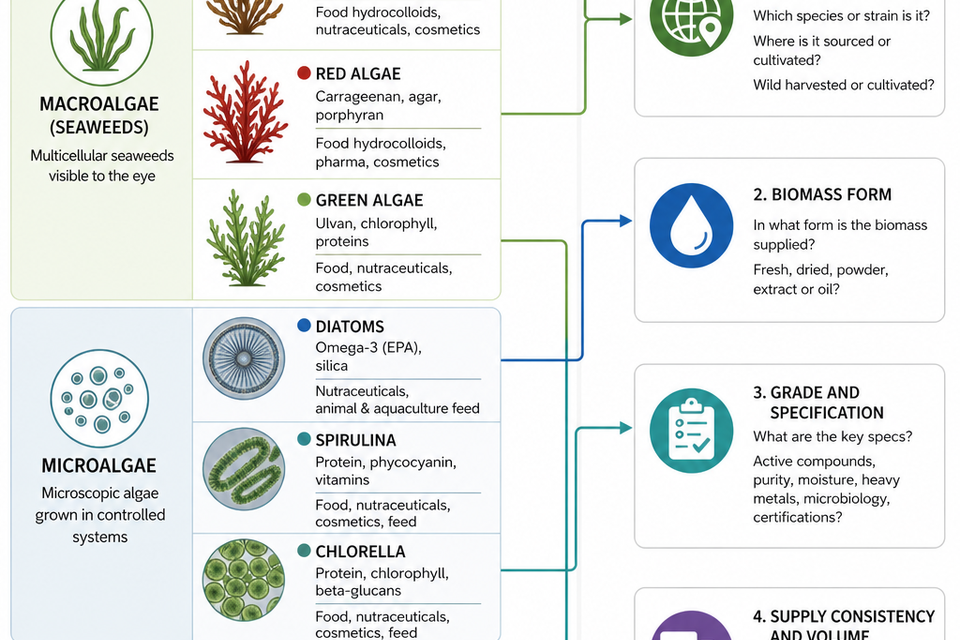
Marine algae is an umbrella term covering very different organisms with different compounds and supply chains. Before sourcing, confirm which group, species, and biomass form your application requires, since these determine specifications, pricing, and supplier fit.
Buyers most often get stuck on three things: batch-to-batch consistency, unclear origin data, and unclear cost per usable unit. You can check all three before you commit to a trial.
Editor note: No forum threads or community discussions were supplied for this section, so the pain points below are framed as common buyer questions. Each needs a cited source before publication.
Pain point 1: One batch performs differently from the next
Marine algae are biological materials. Composition shifts with species, harvest timing, and water conditions. A strong sample tells you little about the lot that arrives six months later.
Ask for a lot-level certificate of analysis with every shipment. Compare at least three consecutive lots before you scale up.
Pain point 2: Origin data is vague
"Marine algae" covers brown, red, and green macroalgae, plus microalgae (phytoplankton). These groups differ in how they grow, how they are harvested, and how long they take to reach harvest size. Wild-harvested and cultivated material can also look similar on a spec sheet.
Treat an origin question as a production-model question. Ask:
- Is the material wild-harvested or cultivated?
- If cultivated, is it open-ocean or land-based?
- Where and when was this lot harvested?
Pain point 3: Cost per usable unit is hard to compare
Quotes often list price per kilogram of wet or dried biomass. That number hides yield. If Supplier B costs 20% more per kilogram but delivers 25% more of the active material you need, B is the cheaper option.
Convert every quote to cost per kilogram of usable material. Then compare quotes on the same basis.
Pain point 4: Implementation risks get little attention
Buyers rarely ask how a supplier handles contamination or toxic blooms. For aquaculture and seafood operators, this matters because some species produce toxins or harm fish. Ask suppliers:
- Which contaminants and species do they test for?
- What happens to a lot that fails testing?
- How do they notify customers about a problem lot?
How to verify claims before a trial
- Request the species name (Latin binomial) and the lot certificate.
- Ask for harvest site, date, and production method.
- Write a spec for the properties you need and agree on test methods upfront.
- Run a small trial and keep retained samples from each lot.
- Test at least three lots before you commit to volume.
Where evidence is still thin
Published comparisons of yield, harvest cost, and scalability across production models are limited in the sources reviewed for this section. Do not treat any supplier's yield or cost claim as settled until they provide their own data. Ask for the test method behind each number.
For a broader view of the material types, visit our alga marina page. If you need help matching a spec to a raw material, see our page on novu sviluppu di materia prima. For company background, read our about us page. For technical questions about your application, cuntattateci.
Cunclusioni
Marine algae are a broad category, so the first step is knowing which group you're actually dealing with. Macroalgae, microalgae, and phytoplankton behave differently in cultivation, harvesting, and specification, and mixing them up is one of the fastest ways to end up with the wrong inputs. From there, most sourcing decisions come down to specifications you can verify: the algae group, form, harvest method, traceability, and lot-level documentation. Natural variability is real, so build your specs and testing plan around it rather than hoping it won't show up.
If you're at the stage of comparing inputs, start by writing down your specification fields using the checklist above, then review the marine algae product page to see how the options line up. If you have technical questions or want to request specifications for a trial, reach out through our contact page. You can also look at our new raw material development page if you're evaluating an input that isn't yet in your standard range.
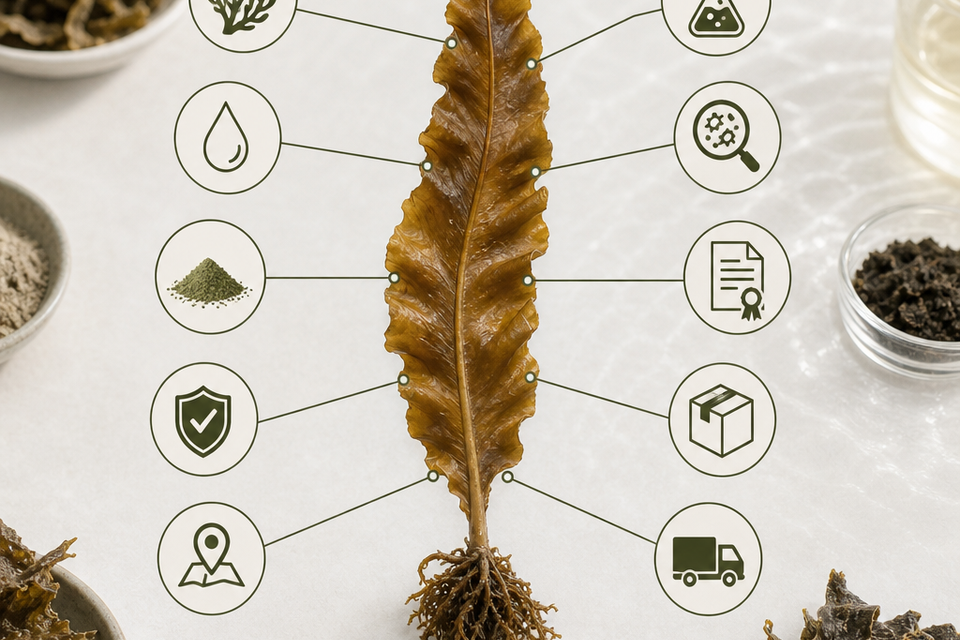
Use this checklist to define marine algae specifications before supplier qualification. Items marked as must-verify, such as species identity, contaminant limits, and Certificates of Analysis, should be confirmed in writing for every lot, because differences in form, origin, or processing can change both functional performance and regulatory compliance.