Which Marine Animals Eat Algae, and Why Seaweed Diets Matter for Aquafeed Sourcing matters because readers need a clear, practical answer to what marine animals eat algae. This article breaks the topic into What Does “Eating Algae” Mean in Marine Systems?, How to Match Algae Type and Operating Context to Grazers, Marine Grazer Comparison: Tangs, Rabbitfish, Snails, Urchins, and Hermit Crabs so the reader can move from understanding to decision-making without fluff.
What Does “Eating Algae” Mean in Marine Systems?
Eating algae means an animal uses living or dead algae as a main food source. The key distinction for buyers is grazing versus scavenging. Grazers bite living algae off rock, coral, or sand. Scavengers pick up dead material and detritus. Most marine algae eaters are generalist herbivores or omnivores, not specialists, so they eat whatever algae they encounter and often other food too.
Think of algae eaters as a mowing crew. The number of workers matters less than the mowing pattern: what they bite, how often, and how deep. A crew that trims the top of each blade keeps a lawn healthy. A crew that rips out roots wrecks it. Reef tanks work the same way.
Many buyers choose grazers by appetite alone, and that often produces the wrong animal. Tangs and some rabbitfish nibble corals and sponges. A fish that clears hair algae but picks at coral creates a bigger problem than the one it solves.
Before you buy, answer three questions:
- Which algae? Hair algae, bryopsis, cyanobacteria, and coralline algae call for different grazers. Coralline algae often belongs in a healthy reef, so it should stay.
- In which system? Reef, fish-only, or outdoor project? Reef safety changes the shortlist.
- At what stocking density? Too many grazers strip the food supply and compete with each other.
Screen candidates in this order:
- Reef safety: Does it eat corals, sponges, or invertebrates?
- Algae specificity: Does it target the algae you need removed and leave coralline algae alone?
- Tank-size fit: Will it reach adult size and move comfortably in your system?
Only after a candidate passes all three should appetite enter the decision.
The same screening logic applies to raw material choices in aquafeed sourcing. Review our marine algae range against your formulation and specifications.
Grazer suitability claims, including those above, should be checked against species-level sources before you rely on them. Behavior varies by individual and by habitat.
How to Match Algae Type and Operating Context to Grazers
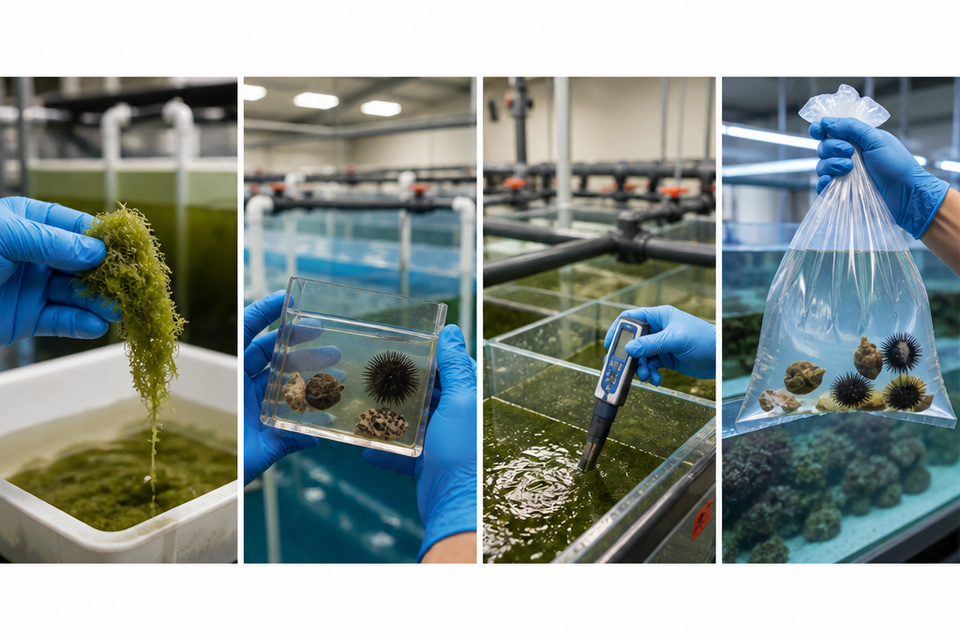
Illustration for How to Match Algae Type and Operating Context to Grazers
The right grazer depends on two things: the algae you need to control and the system you run. “What eats algae?” has no single answer. A reef tank, a commercial aquarium supplier, a kelp restoration site, and an aquaculture operation each need different grazers.
Start with two axes
Map algae category against operating context. Each intersection gives you a short list of candidate grazers to check.
- Algae category: hair algae and bryopsis, cyanobacteria, coralline algae, kelp and macroalgae, seagrass-associated growth.
- Operating context: home aquarium, commercial aquarium supplier, kelp restoration project, integrated aquaculture.
Screen candidates in this order:
- Reef safety first. Eliminate any grazer that eats corals, sponges, or invertebrates. Tangs and some rabbitfish nibble coral or sponges, so they fail this step in reef systems.
- Algae specificity second. Confirm the grazer eats your target algae. A species that clears hair algae may ignore cyanobacteria.
- Tank or site fit last. Check tank size, care needs, and whether the grazer survives your water conditions.
Check trade claims against species references
Many grazer lists in trade literature cite no source. Before you buy, check each species in a species-level reference. If a reliable source flags a species as reef-hostile, drop it from reef-tank shortlists. That single rule removes most costly mistakes.
Wild ecology sets the baseline
In the ocean, urchins, green turtles, dugongs, manatees, and parrotfish graze kelp, seagrass, and macroalgae. When urchin populations collapse, kelp can give way to barren rock, known as an urchin barren. Restoration buyers should treat grazer density as a design variable, not a background fact.
Diet quality matters for aquafeed sourcing
For aquafeed buyers, the same logic applies to seaweed raw materials. Ask suppliers for:
- Species identified by Latin name, not just “seaweed”
- Harvest location and season
- Contaminant and nutrient test results per batch
- Consistency data across lots
Specifications vary by use case, so request them before you compare prices. Review the marine algae range for current options. If your formulation needs something the catalog doesn’t cover, check new raw material development, or contact us with your target spec.
Marine Grazer Comparison: Tangs, Rabbitfish, Snails, Urchins, and Hermit Crabs
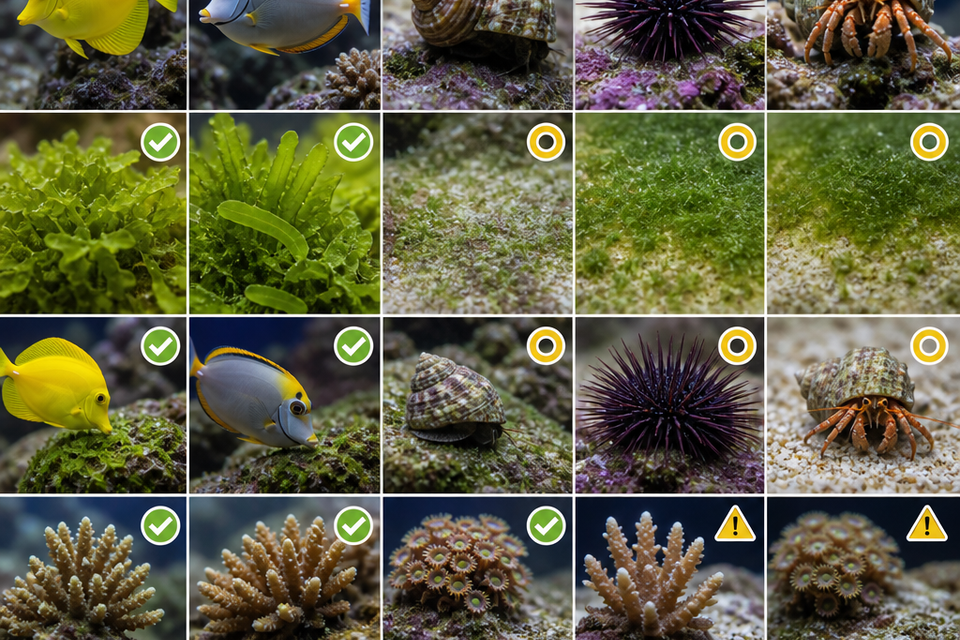
Illustration for Marine Grazer Comparison: Tangs, Rabbitfish, Snails, Urchins, and Hermit Crabs
Tangs and rabbitfish clear the most algae, but they carry the highest risk of nibbling corals and sponges. Snails are the safest general-purpose grazers, and urchins and hermit crabs suit only specific setups. Choose by the algae you have, what lives in the tank, and how much space you can give the animal.
Side-by-side comparison
| Grazer group | Algae it tends to target | Reef-safety notes | Space and care needs |
| Tangs | Filamentous and film algae | Some species nibble coral, sponges, or clams | Large swimming space; species-specific diets |
| Rabbitfish | Macroalgae and film algae | Some individuals pick at corals or sponges | Moderate to large tanks; varies by species |
| Snails (e.g., Mexican turban) | Hair algae, film algae | Generally low risk to corals; may knock over small polyps | Small footprint; easy to keep |
| Urchins | Macroalgae, film algae, some coralline | Can scrape coralline and damage rock and corals | Sturdy setups; spines can injure other animals |
| Hermit crabs | Some algae, plus detritus and leftovers | Often pick at snails or dead tissue; some stress other invertebrates | Need spare shells and room to molt |
Use this table as a starting point. Species-level behavior varies, and the table does not replace checking each species before you buy.
Reef-safe versus reef-hostile decision matrix
- Choose snails when you need to control hair algae or bryopsis in a reef tank and want low coral risk.
- Choose tangs or rabbitfish only for fish-only or fish-dominant systems, or for reef tanks with hardy corals and proven behavior from your supplier.
- Choose urchins for macroalgae removal in systems where coralline and rockwork are not priorities.
- Limit hermit crabs to tanks where you can supply extra shells and monitor snail losses.
- Expect little help on cyanobacteria. Grazers rarely clear it alone. Flow and nutrient fixes usually do more.
Why “reef-safe” labels need checking
“Reef safe” is a seller classification, not a standard. No single agency defines it, so two suppliers can use the same label for animals with different habits. Treat the label as a starting claim, then verify it yourself.
Some hobbyists argue that a grazer that worked in one tank is safe for all tanks. However, one tank tells you little. Water flow, coral species, and the animal’s age all change the result.
Set up a procurement log
Record every grazer purchase in one shared sheet. Include:
- Species name and the supplier’s listed label
- Supplier name and batch or order date
- Observed behavior: coral nibbling, snail harassment, or spine damage
- Algae cleared, with a rough before-and-after note
- Observation window, such as the first 30 days
The 30-day window matters most. Add a second grazer only after the first one has shown its behavior over that period. Logs also help you compare suppliers over time, which a single purchase cannot show.
What Eats Algae in the Wild Ocean and What Happens When Grazers Disappear
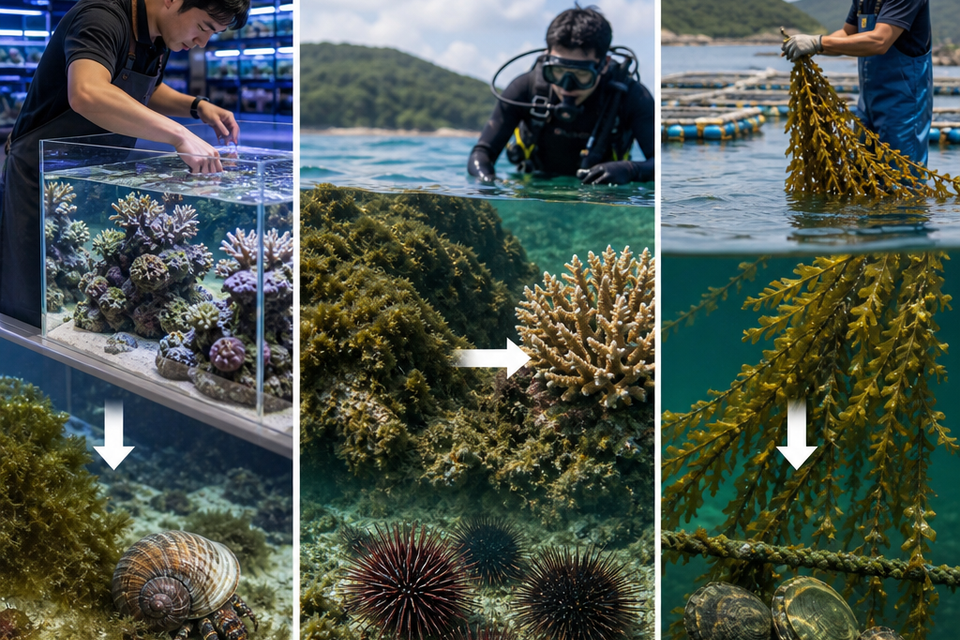
Illustration for What Eats Algae in the Wild Ocean and What Happens When Grazers Disappear
Sea urchins, parrotfish, green turtles, dugongs, and manatees all eat algae. When their numbers drop, algae can overgrow the habitat, or the remaining grazers can overeat the kelp and seagrass they depend on.
Who grazes what
- Sea urchins graze kelp and macroalgae on rocky reefs.
- Parrotfish scrape algae from coral reefs, which keeps algae from smothering corals.
- Green turtles, dugongs, and manatees graze seagrass and macroalgae in shallow coastal beds.
What happens when grazers disappear
Losing a predator can flip a system. When sea otters or lobsters decline, urchin numbers can climb and overgraze kelp. The result is an urchin barren: bare rock with few kelp plants left.
Effects differ by region. Restoration plans and grant applications should rely on local survey data, not a general reef model.
Illustrative scenario (hypothetical, not a real customer)
Imagine a mid-size aquafeed buyer evaluating a seaweed-based ingredient for an abalone or sea urchin operation. Before ordering, the buyer asks four questions:
- Is the algae species consistent from lot to lot?
- Does every lot have toxin test documentation, or only a batch-level certificate?
- How does the ingredient change stocking density limits, given its nutrient profile and feed rate?
- What cross-border shipping and permit rules apply to each shipment?
Set the acceptance rule before the first order. If one lot fails testing, the buyer holds that lot, not the whole supply.
For product specifications, review our marine algae page and contact us to request a specification sheet.
Real-World Applications: Aquarium Supply, Restoration, and Integrated Aquaculture
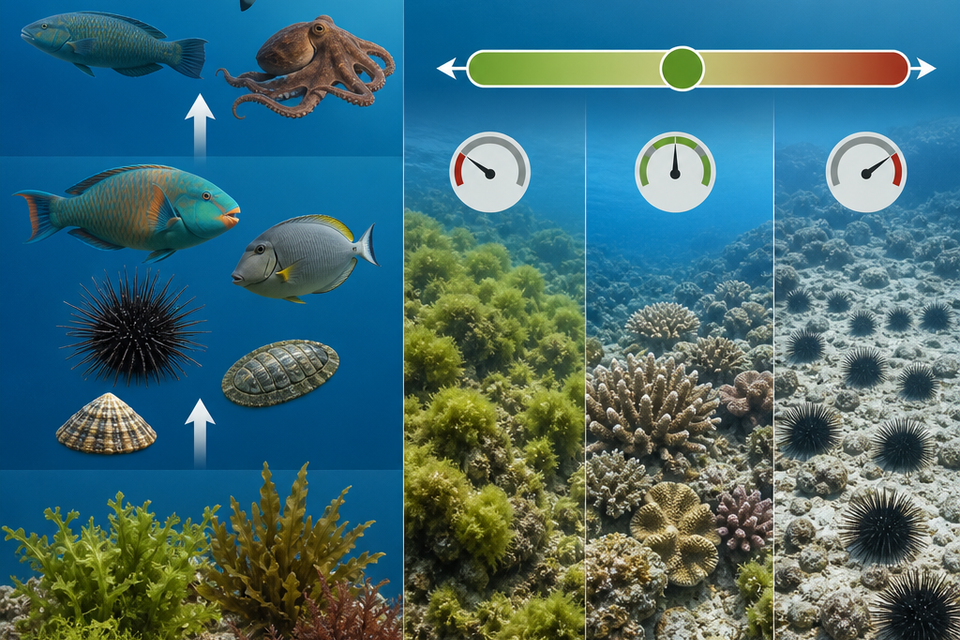
Illustration for Real-World Applications: Aquarium Supply, Restoration, and Integrated Aquaculture
Algae-eating animals matter in three real-world settings: stocking reef aquariums, rebuilding kelp forests, and feeding farmed shellfish. Each one turns on a different decision and needs a different proof point.
1. Aquarium supply: match the grazer to the reef
A commercial aquarium supplier sells algae-control animals to hobbyist reef tanks. The key decision is whether a species eats only nuisance algae or also corals, sponges, or invertebrates. Some tangs and rabbitfish nibble corals or sponges, so a “reef safe” label on the wrong species leads to returns and damaged trust.
- Verification step: Check each species’ diet against peer-reviewed or aquarium-science sources. Then test a small group in a quarantine tank before listing it.
2. Kelp restoration: plan grazer control before planting
Sea urchins can strip a kelp forest into bare rock. Where predators such as sea otters have declined, urchin numbers often rise and clear the kelp. Restoration planting fails if urchins are still dense enough to eat new kelp.
- Decision variable: Urchin density relative to kelp recovery goals.
- Verification step: Survey urchin density and kelp cover before work starts. Record the baseline in the grant application so funders can check results later.
3. Integrated multitrophic aquaculture: seaweed as feed
Abalone and sea urchins can eat seaweed grown alongside them in the same system. This setup uses waste nutrients from one species as food for another.
- Decision variable: Whether seaweed supply stays consistent across the year.
- Verification step: Request species identification and harvest records for every shipment.
Illustrative scenario: a mid-size aquafeed buyer
This is a hypothetical buyer, not a real customer case. Imagine a procurement lead evaluating a seaweed-based ingredient for an abalone operation. Before signing, the buyer should ask:
- Species consistency: Is the same species harvested in every lot? A switch between kelp species changes nutrient content and can change how the animals respond.
- Lot-level toxin documentation: Does each lot include its own test results for heavy metals and biotoxins? One certificate for the first batch does not cover later shipments.
- Stocking density implications: Higher stocking density means more feed per tank. Confirm that the supplier’s data covers your planned density, not just lower-density trials.
- Cross-border shipping and permits: Confirm import rules in both countries and who holds the permits. Customs delays can cost more than any price advantage.
Treat any growth or feed-conversion figure from a supplier as unverified until it links to a peer-reviewed or agency source.
To review species options and lot documentation, start with the marine algae page. Send your volume, density, and testing requirements through the contact page to request specifications.
Benefits and Limitations of Using Marine Grazers
Marine grazers cut algae well, but they rarely fix the cause. They work best as one control among several.
Benefits: Grazers remove algae biomass without chemicals. Sea urchins and abalone eat macroalgae directly, so one organism handles both the feeding and the clean-up.
Limitations:
- Grazers cannot remove the nutrients that feed a bloom. Some buyers treat them as a cheap fix. However, if nutrients keep entering the system, algae regrows faster than grazers can clear it.
- Overgrazing causes its own damage. When urchin populations surge, they can strip kelp beds to bare rock, a condition ecologists call an urchin barren.
Illustrative scenario (hypothetical, not a real customer): A mid-size aquafeed buyer considers a seaweed-based ingredient for an abalone operation. Before ordering, the buyer asks four questions:
- Is the algae species consistent? Shifting species between lots changes nutrient content and how animals respond.
- Does each lot have toxin testing documentation? Ask for lot-level records, not a general certificate.
- How does the ingredient change stocking density? Ask what feeding rate the supplier assumes and how it affects water quality.
- What permits apply to cross-border shipping? Confirm who holds the import documents before the first shipment.
For specification requests, review our marine algae page and contact us.
Common Misconceptions About Marine Algae Eaters
Three common myths lead buyers to pick the wrong grazers. Each one has a simple correction.
Myth 1: “All reef snails eat all algae.” Grazing specificity varies widely. Check which algae category a species targets before you buy it.
Myth 2: “More grazers always means a cleaner tank.” Overstocking adds competition, waste, and aggression. Size the stock to the system’s capacity, not to the algae you see.
Myth 3: “Seaweed-eating animals are automatically safe to eat or feed.” Diet does not guarantee safety. Section 8 covers the testing questions to ask.
Illustrative scenario (hypothetical, not a real customer): A mid-size aquafeed buyer is evaluating a seaweed-based ingredient for an abalone operation. Before ordering, the buyer asks:
- Is the algae species consistent from lot to lot?
- Does each lot include toxin testing documentation?
- How does the planned feeding rate affect stocking density?
- Which cross-border shipping and permit rules apply?
To compare ingredient options, start with the marine algae page. For specification requests, use the contact page.
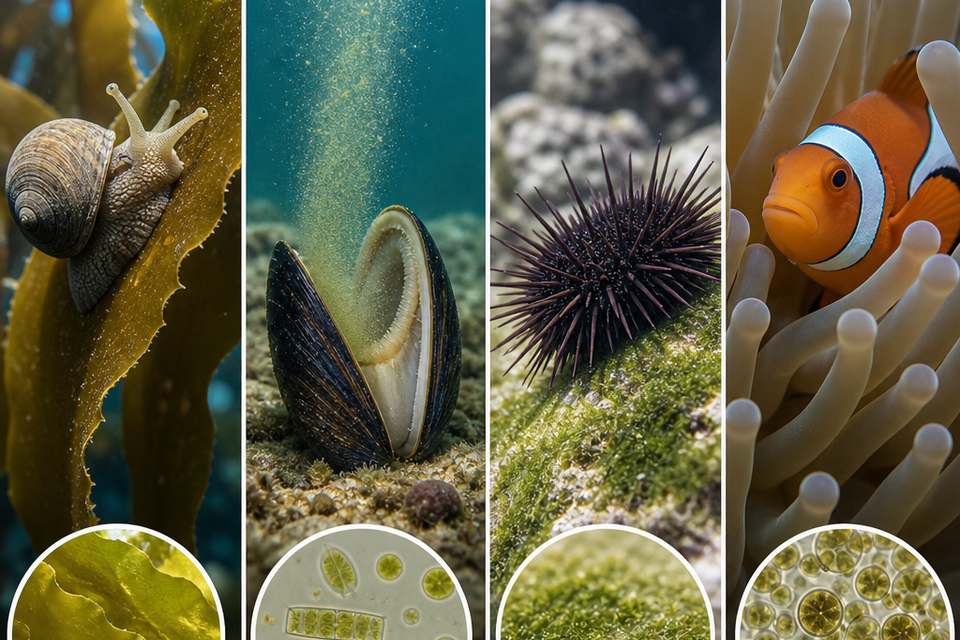
Illustration for What Does “Eating Algae” Mean in Marine Systems?