If you’ve spotted brown, green, or slimy growth in seawater or on an intake line, your first question is usually simple: what is it, and does it matter? In short, marine environments mainly contain three algae groups: microalgae that float in open water (phytoplankton such as diatoms and dinoflagellates), cyanobacteria that often show up in the same samples, and macroalgae, the attached seaweeds like brown, red, and green species. Habitat tells you more about relevance than taxonomy does at first.
This guide shows how to sort what you see by habitat, light, and nutrient conditions, then connects each group to real decisions in aquaculture, water treatment, and biotech sourcing. You’ll see how to narrow identification in the field, where visual cues fall short, which harmful bloom risks to watch, common mistakes to avoid, and how to find regional species checklists you can rely on.
What Are Marine Algae? A Plain-Language Classification
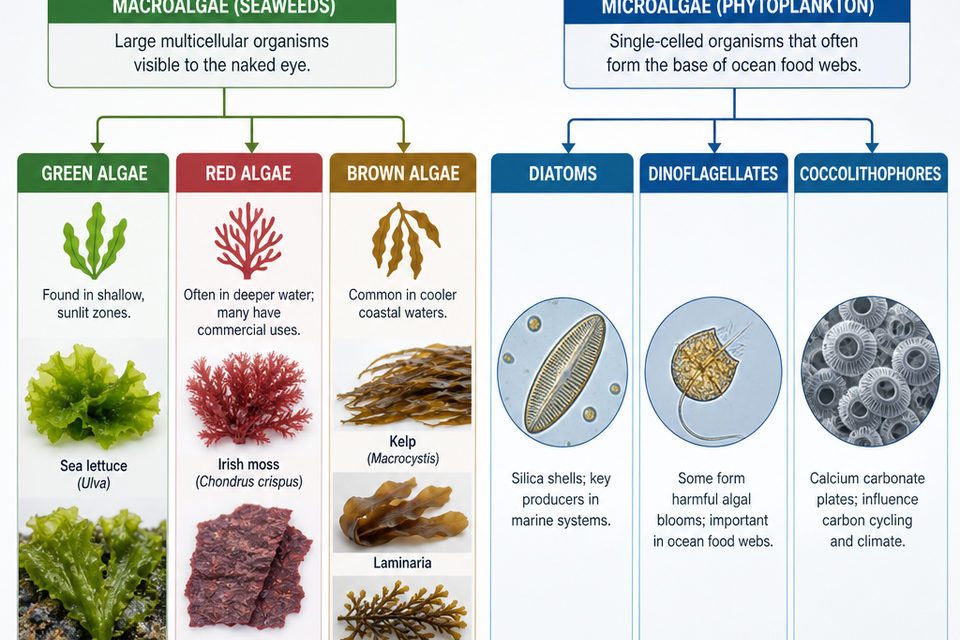
Marine algae fall into two broad categories by size: macroalgae (seaweeds) and microalgae (phytoplankton). Within macroalgae, pigment color (green, red, or brown) is the main way to tell groups apart. Most marine algae you will encounter belong to one of these groups.
Marine algae fall into three practical groups: microalgae, cyanobacteria, and macroalgae. Buyers sort them by where they grow and how big they are, because those two traits predict what each group can do for an application.
Think of marine algae as a city’s workforce. Phytoplankton are the commuters. They drift through open water and go wherever currents take them. Seaweeds are the fixed-site workers. They anchor to rock or seabed where enough light reaches them.
Pelagic algae live in the water column. Most are microscopic, and they need light near the surface plus dissolved nutrients such as nitrogen and silica. Open ocean holds most of the marine algal biomass, which explains why clear water looks empty to the eye.
Benthic algae grow attached to the seabed. Seaweeds need a hard surface and light that reaches the bottom, so they cluster in shallow, clear coastal zones.
Cyanobacteria are prokaryotes, not true algae. They appear in the same samples and monitoring programs, so include them in your sampling plan.
| Group | Typical form | Where it grows | Key light and nutrient needs | Typical buyer relevance |
| Diatoms | Single-celled, silica shells | Open water and surface sediments | High light, dissolved silica and nitrogen | Feed for hatcheries, filtration fouling |
| Dinoflagellates | Single-celled, two flagella | Open water, stratified water | Variable light, can be mixotrophic | Toxin risk, bloom monitoring |
| Cyanobacteria | Single cells, filaments, mats | Surface water, sheltered areas | Light and nutrients, often warm conditions | Toxin risk, water quality monitoring |
| Macroalgae (brown, red, green) | Multicellular seaweed | Attached to rock or seabed in the light zone | Light reaching the bottom, hard substrate | Harvested biomass, food and ingredient sourcing |
Field cue: Under a microscope, diatoms show a glassy, patterned shell. Dinoflagellates show armored plates and often swim. Visible fronds or filaments usually point to macroalgae or cyanobacteria.
Risk: A surface scum can look like diatoms but may be cyanobacteria. Send samples to a lab for identification before you treat water or buy biomass.
Decision criterion: If you handle harvested material by weight, you work with seaweed. If you filter or dose cells in suspension, you work with microalgae. Explore marine algae sourcing options or contact our team to match a group to your application.
Pelagic vs. Benthic Algae: Habitat Zones, Light, and Nutrients
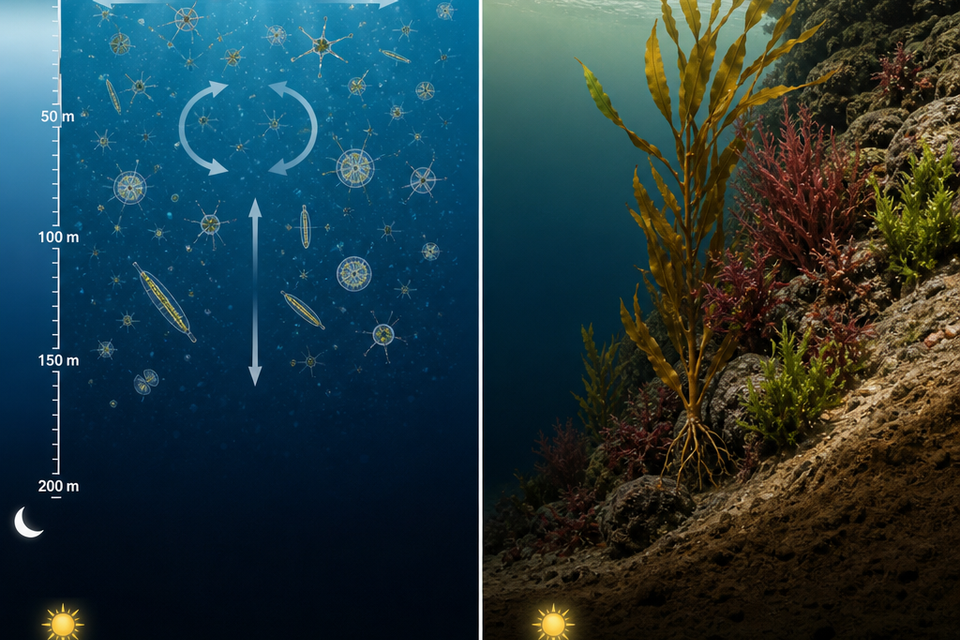
Pelagic algae drift freely through the sunlit upper ocean and depend on nutrients mixed up from deeper water, while benthic algae stay anchored to the seafloor and draw on light and nutrients from the nearby substrate and water. Light availability, which falls off sharply with depth, is what separates where each group can thrive.
Most marine algae live in open water, not on the seabed. Pelagic phytoplankton drift in the sunlit upper ocean, while benthic seaweeds attach to rock near shore. So when someone asks where the algae is, the honest answer often starts with the open sea.
Pelagic algae are sparse per liter. A liter of open seawater holds only a few cells, so the ocean looks clear. Color appears only during blooms, when cell counts rise enough to tint the water. Marine primary production is widely quoted as roughly half of global primary production. Verify the current figure against a primary source before you publish it.
Benthic algae need light that reaches the bottom. That limits them to the photic zone. In clear water, that zone reaches the upper tens of meters. In turbid estuaries, it shrinks far more. This is why kelp forests and intertidal beds cluster near coasts.
Three drivers decide where each group grows:
- Light: Depth and turbidity set the limit. Sediment and runoff cut light fast.
- Nutrients: Upwelling brings nitrate and phosphate from deep water. River runoff and sewage add them near shore. Extra nutrients can fuel growth, but sewage-driven blooms can also cause problems.
- Substrate: Benthic seaweeds need hard surfaces such as rock to attach to. Sand and mud rarely support kelp.
Checking a Regional Species Checklist
Procurement, permitting, and environmental-assessment teams need checklists they can defend. Use this method:
- Identify the maintainer. Note whether a government agency, university, or expert network owns the list.
- Confirm the taxonomic authority. Check which naming system the list follows and its version.
- Check geographic coverage. Confirm the list covers your exact bioregion, not just a broad ocean basin.
- Check the last revision date. Old names may now be synonyms.
- Look in common hosts. Global registers and biodiversity databases such as WoRMS and OBIS often hold regional records. Regional government and university repositories may hold more local data. Treat any specific regional list as an item to verify, not a confirmed reference.
- Cross-check the claim. Confirm each species name in at least two independent sources. Look for dated occurrence records with locations. If sources conflict, contact the maintainer or a local phycologist.
A wrong name can stall a permit or weaken a sourcing spec, so build this check into your timeline before you rely on the list.
How to Tell Diatoms from Filamentous and Macroalgal Growth in a Water Sample
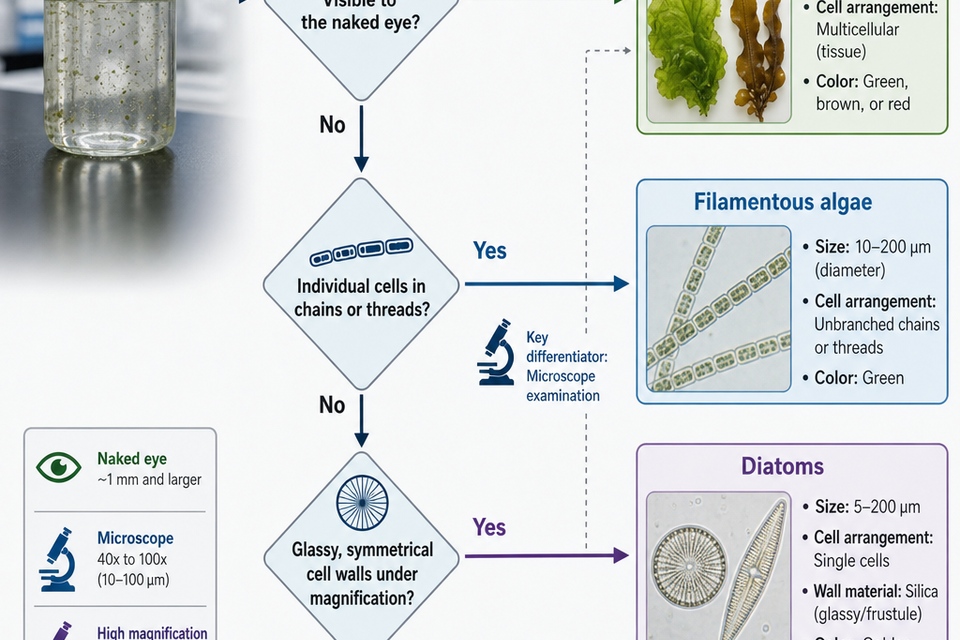
Start with the naked-eye check, then use microscope magnification to separate single-celled diatoms, which have glassy silica walls, from chain-forming filamentous algae. Macroalgae are identified by size alone.
Diatoms look like golden-brown cells or films. Green threads or mats point to filamentous algae or attached seaweed. Visual cues only narrow the group, so a microscope count or lab identification is still needed.
Start with shape and colour. Diatoms are single cells that form a golden-brown haze or slime on surfaces. Visible strands, tufts, or mats point elsewhere, usually to filamentous green algae, filamentous cyanobacteria, or macroalgal fragments. Dinoflagellates often tint water reddish or brown and may swim, so colour alone misleads. Cyanobacterial mats look blue-green or dark and often smell earthy.
Example (fictional). A water treatment operator and an aquaculture buyer each receive a sample of green filaments from an intake line. Both start with the same habitat table:
| Setting | Likely group |
| Dark intake line, nutrient-rich water | Filamentous green algae or cyanobacteria |
| Seabed-attached intake, seaweed fragments | Macroalgae (benthic) |
| Sunlit open water, suspended cells | Phytoplankton, such as diatoms |
The operator asks which depth the intake draws from and how much light reaches the line. A dark line with nutrient runoff raises biofouling risk. The buyer asks whether the sample came from a seabed source or open water. Attached fragments point to macroalgae, while suspended cells point to phytoplankton. The same green sample leads each reader to a different risk call.
Record before you send it to a lab. Note the location, depth, date, and a photo with a scale bar. If the source is unclear, collect at least two depths. Lab staff can then match the sample to the right group faster.
Field observation alone rarely confirms identity. Diatoms and dinoflagellates look alike at low magnification, so budget for a microscope count before you act.
Use Cases and Applications Across Aquaculture, Water Treatment, and Biotech
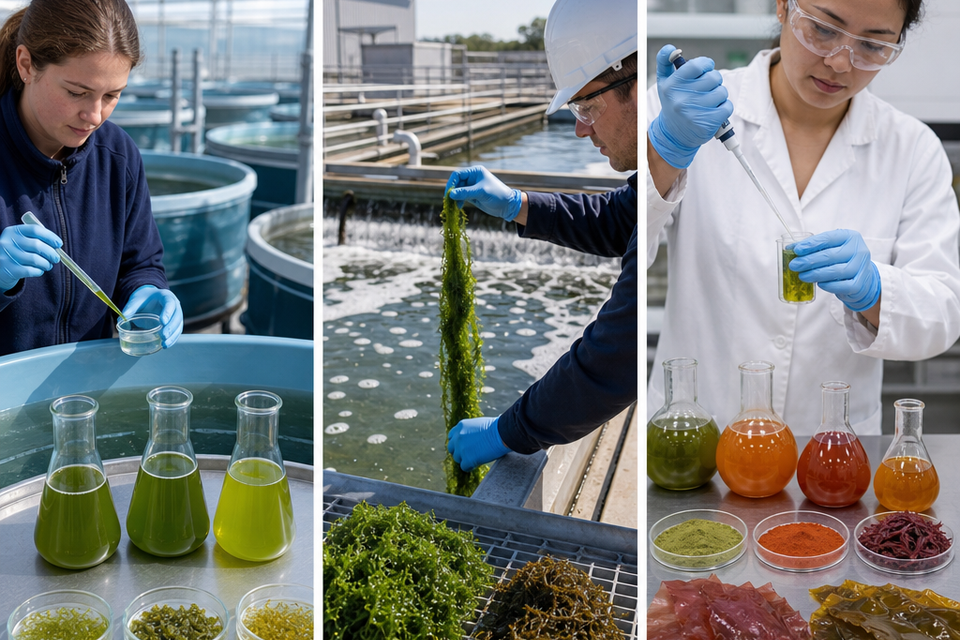
Marine algae serve different functions depending on the application. Microalgae dominate live feed and high-value compound production, while macroalgae are used for nutrient management and hydrocolloid extraction. Match the algae type to your application’s output requirements before selecting a species or supplier.
Each application needs a different algae group. Buyers who order generic “marine algae” or “seaweed” risk getting a species that fails their process. Name the species and grade in your spec.
Aquaculture hatcheries use cultured microalgae, mainly diatoms and green algae, as live feed for larvae. The key risk is culture purity, because an unwanted species can change nutrition or crash a culture. Check each batch under a microscope. Diatoms show glassy, patterned silica cell walls. Dinoflagellates swim with two flagella. Filamentous growth appears as visible threads.
Coastal water treatment and desalination intakes face fouling from macroalgae and diatoms. Diatoms build slime layers on screens, membranes, and pipes. Test the surfaces, not only the water. A clear water sample does not show what is building up on the equipment.
Biotech and extract producers use macroalgae as biomass. Brown kelp supplies alginate. Red seaweeds such as nori (Porphyra) supply carrageenan and agar. Green Ulva is a newer input to evaluate. Species, harvest season, and site all change the material you receive.
Some buyers argue a generic “seaweed” spec saves time with suppliers. However, that spec lets a supplier ship a species your process was never tested on.
| Application | Algae group | Spec items | Sampling method |
| Hatchery live feed | Diatoms, green microalgae | Species list, culture purity limit | Microscope check per batch |
| Intake fouling | Diatoms, macroalgae | Surface biofilm condition | Screen and coupon inspection |
| Hydrocolloid biomass | Kelp, nori/Porphyra, Ulva | Species ID, harvest season, site | Lab species ID, seasonal lot testing |
Set your own limit for unwanted species, and write it into the contract. Reject lots that exceed it.
Visual checks alone cause mistakes, especially with mixed samples. Treat them as screening, not identification.
Pricing varies by species, grade, and season. Request quotes against the same written spec. Market growth claims for Ulva and other newer species differ across sources, so verify them against current industry data before you budget.
Explore marine algae products or review new raw material development for novel inputs.
Which Marine Algae Cause Harmful Blooms and What the Operational Risks Are
Only a short list of phytoplankton species causes harmful blooms, and those few drive most monitoring and infrastructure decisions. Most marine algae are harmless. The risk comes from toxin producers and from dense blooms that deplete oxygen or clog equipment.
Representative species to check against current regional advisories:
- Alexandrium (dinoflagellate): produces paralytic shellfish toxins that build up in shellfish.
- Pseudo-nitzschia (diatom): produces domoic acid, which also accumulates in shellfish.
- Karenia brevis (dinoflagellate): causes Gulf of Mexico red tides linked to fish kills and respiratory irritation on shore.
- Ostreopsis (benthic dinoflagellate): linked to respiratory irritation in some regions.
Map each bloom type to an operational risk:
- Toxins close shellfish harvests and cause finfish mortality.
- Hypoxia from decomposing blooms stresses or kills farmed fish.
- High biomass clogs intakes and interrupts water treatment.
- Certain cyanobacteria cause taste and odor problems in drinking water.
Risk depends on which species live in your region, so a list from one coast does not transfer to another. Use national or regional harmful algal bloom programs for thresholds and closure notices, not general articles. Sampling and lab results can trail a bloom, so build response time into your operating plans.
The same logic applies to “seaweed.” Kelp (brown), nori/Porphyra (red), and sea lettuce/Ulva (green) differ in classification, growing conditions, and product specifications. A purchase order for “marine algae” invites mismatched material. Specify species, grade, and origin in supplier qualification. Some buyers argue a generic spec is enough for low-stakes uses. However, the same vague label makes it hard to trace contamination or prove what you bought.
Require a species name and a grade sheet for every lot. Check any market-direction claims about these categories against current industry data before you build them into forecasts.
Illustrative Scenario: Green Filamentous Growth in an Intake Line (Fictional)
This scenario is fictional. It shows how one green, filamentous sample can lead to different decisions depending on where it was collected and how it will be used.
A water treatment operator and an aquaculture buyer each receive a sample of green, filamentous growth from the same intake line. Both see the same green mass, but they need different answers.
The operator’s path
The operator starts with the habitat table. Attached filaments in an intake usually point to benthic macroalgae or filamentous green algae growing on pipe walls, not open-water phytoplankton. The first question is light: does the intake draw from shallow, sunlit water? If so, the likely response is a cleaning and treatment schedule, not an emergency.
The buyer’s path
The buyer asks a different question: could this material enter a culture tank? Attached growth on a pipe matters less than free-floating cells in the water column. The buyer asks four things:
- Was the sample taken at the surface or at intake depth?
- Is the growth attached or free-floating (pelagic)?
- Is the intake shaded or sunlit?
- What feeds the growth: runoff, wastewater, or upwelling?
Each answer shifts the likely group and urgency. Nutrient-rich runoff in sunlit shallow water favors fast-growing green filaments. A deep, shaded intake points away from them.
Why the label matters
The same visual cue carries different risk depending on habitat and application. Calling the sample “marine algae” hides that difference. Write the sampling depth, growth form, light condition, and intended use into every lab or supplier request.
This applies to purchased seaweed too. Kelp, nori (*
Benefits and Limitations of Habitat-Based Classification
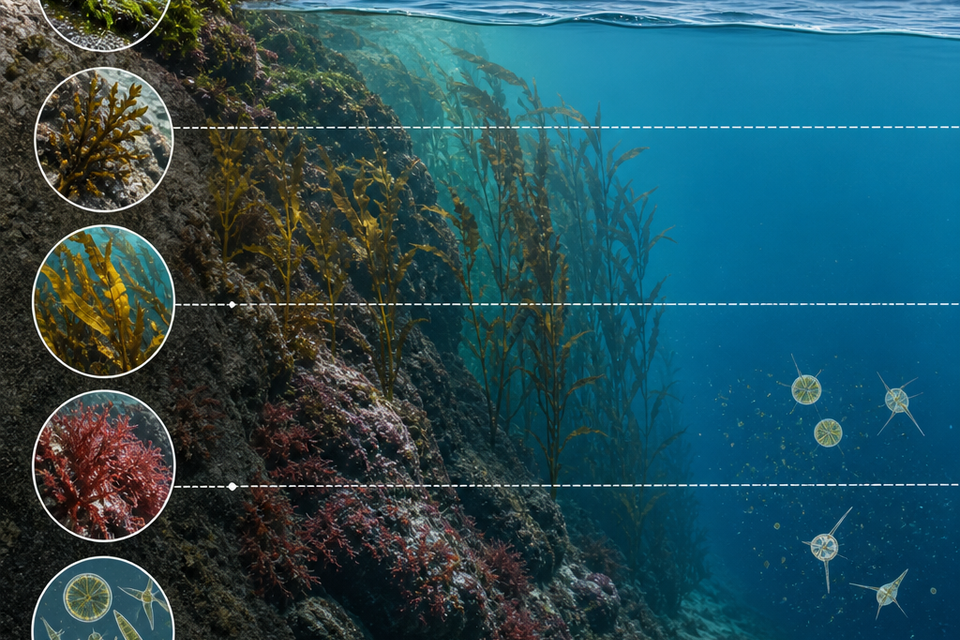
Habitat-based classification sorts marine algae by where they live, which makes it useful for ecology and field surveys. Because many species span multiple zones and habitat says little about evolutionary relationships, it should be used alongside taxonomic classification rather than in place of it.
Habitat-based classification sorts marine algae by where they live: open water (pelagic), the seabed (benthic), or both. It works as a fast screening tool, but it cannot confirm what an organism is.
Where it helps
- It gives non-specialists a first-pass filter. Sampling programs use habitat groups to design surveys, so the labels match how field data is collected.
- It links algal group to application risk. Open-water phytoplankton, such as diatoms, and seabed macroalgae call for different handling, monitoring, and supply specifications.
Where it breaks down
- The boundaries overlap. Some organisms move between pelagic and benthic stages. Mixotrophic dinoflagellates blur the line between photosynthesis and feeding.
- Visual cues create false confidence. Shape and color in a water sample can suggest diatoms or filaments. Only microscopy confirms the identity.
- Regional species vary. A habitat table screens candidates. It does not replace local identification.
Some specialists argue taxonomy should come first. They are right that taxonomy confirms identity. However, buyers need a usable decision before full identification, so habitat works better as the screening layer.
Why species and grade matter
“Seaweed” is not one purchasable category. Kelp, nori (Porphyra), and sea lettuce (Ulva) differ in classification, growing conditions, and product specifications. Write the species and grade into supplier qualification instead of the label “marine algae.” Verify any market-direction claims against current industry data before you rely on them.
Common Algae Identification Mistakes Practitioners Make
Most identification mistakes start with one habit: treating “algae” as a single thing. Community posts often show people who cannot tell whether what they see is diatoms or something else, then act on the wrong guess.
Mistake 1: Treating all brown water as diatoms. Brown color can come from sediment, dinoflagellates, or decaying organic matter. Fix: Filter a sample and check it under a microscope before you dose or test for diatoms.
Mistake 2: Assuming green filaments are harmless. Some filamentous green growth and cyanobacteria can foul surfaces or cause taste and odor problems. Fix: Identify the filament type before you label it harmless.
Mistake 3: Sampling only at the surface. The risk often sits at intake depth or on the seabed. Fix: Sample at intake depth and along the bottom.
Mistake 4: Using a species list from another region. A list from one coast can miss species on yours. Fix: Confirm the list covers your geographic area before you rely on it.
The sourcing risk runs deeper. “Seaweed” is not one product. Kelp, nori (Porphyra), and sea lettuce (Ulva) differ in classification, growing conditions, and specifications. Write the species and grade into your supplier qualification, not the generic “marine algae” label. That step makes a bad batch easier to reject.
Verify any market-direction claims about these categories against current industry data before you use them in a business case.
Getting Started: Finding and Confirming Regional Marine Species Checklists
A regional checklist is only useful if it matches your coast, your depth zone, and your purpose. Define those three things first, then find a list that fits and confirm it with a second source.
Step 1: Define the region, depth, and application.
- Region: Name the bay, coast, or sea area. “Pacific Northwest” is too broad for a site survey.
- Depth zone: Open-water phytoplankton, intertidal algae, and subtidal kelp appear in different records.
- Application: A permit report, an aquaculture stock plan, and a water treatment study need different levels of detail.
Step 2: Find candidate sources. Check these four, and confirm each is still online and maintained before you cite it:
- WoRMS (World Register of Marine Species)
- AlgaeBase
- OBIS (Ocean Biodiversity Information System), for site occurrence records
- Your national or provincial environment agency checklist
Step 3: Screen each checklist. A usable checklist states:
- The taxonomic authority
- Its geographic coverage
- The date of last revision
- The maintaining institution
If any item is missing, treat the list as a starting point, not a reference.
Step 4: Cross-check. Confirm each local species claim against at least two independent sources. Then check OBIS for records at your site. If the sources disagree, ask a regional taxonomic expert to confirm the identification.
Consider a buyer scoping sea lettuce (Ulva) on a coast with no local list. The team starts with a Puget Sound checklist because it’s the first one they find. That list doesn’t cover their bay, so every species claim needs rebuilding.
Step 5: Ask the regulator first. Regulators often specify which list to use. Ask before you build a report on a general list.
Name the species, not “seaweed.” “Seaweed” hides real differences. Kelp is a brown alga, nori (Porphyra) is a red alga, and sea lettuce (Ulva) is a green alga. They differ in classification, growing conditions, and product specifications. Write the genus or species and product grade into supplier qualification. Some buyers prefer a broad category to keep options open. However, a generic label lets suppliers substitute without a clear spec to test against.
Verify any market-direction claims about these species against current industry data before you rely on them.
For sourcing options, see our marine algae range, or contact us to discuss your region.
Frequently Asked Questions
Marine algae fall into two practical groups: microscopic phytoplankton that drift in open water, and larger seaweeds that grow on the seabed. For sourcing, naming the exact species and grade protects you far better than ordering “marine algae.”
Why doesn’t the open ocean look like it has algae?
Most open-ocean algae are too small to see. A healthy patch of water looks clear even when it holds millions of cells per litre. You notice them mainly during blooms, when the water turns green or brown.
Are cyanobacteria actually algae?
Not strictly. Cyanobacteria are bacteria, although they photosynthesize and are often called “blue-green algae.” List them as a separate category in your specification so suppliers cannot blur the two.
Can I identify diatoms from a photo alone?
No, not reliably. Diatoms have silica shells that you usually need a microscope to see. A phone photo cannot separate diatoms from dinoflagellates or filamentous algae. Send a preserved sample to a taxonomist when identity matters.
How do I know which species list applies to my site?
Work through three checks:
- Match the species list to your water body, salinity, and light conditions.
- Confirm the supplier’s identification at genus and species level.
- Write grade, moisture, and contaminant limits into the purchase contract.
Kelp, nori (Porphyra), and sea lettuce (Ulva) differ in classification, growing conditions, and product specifications. An order for “seaweed” that names none of them invites substitution. Require a batch-level certificate of analysis for every delivery.
Some buyers assume one supplier can cover every macroalgae application. However, each group behaves differently in processing and use. Check any market-direction claims against current industry data before you rely on them.
Ready to compare species and grades? Explore our marine algae range or contact our team with your application details.
Conclusion
The most useful way to think about marine algae is by where they grow and what they do there. Floating phytoplankton, attached seaweeds, and cyanobacteria each create different risks and different buying questions. Use habitat to screen quickly, use visual cues only as a starting point, and rely on microscopy or lab identification before making a costly call on treatment, culture, or supplier qualification.
If you’re working through a specific sample or sourcing decision, start by documenting location, depth, date, and a scaled photo, then check your findings against a verified regional checklist. For help identifying a sample or evaluating marine algae inputs for your application, contact our team at https://www.landivine-lab.com/contact-us/.