Cosmetic emulsion formulation development starts with three linked decisions: define the emulsion system, assign each ingredient a clear job, and test the finished prototype under controlled conditions. A cream can look uniform on the day it is made and still show physical instability later. A thicker sample is not automatically a more stable one, and a visible liquid-crystal structure does not by itself prove that the final formula will remain stable throughout storage and use.
For formulators, the useful question is not simply “Which emulsifier should I use?” It is “What does this formula need the emulsifying system, rheology modifiers, and structural ingredients to do, and what evidence will show that the system is working?” The process below focuses on that decision path for cosmetic creams and lotions.
Start with the Emulsion Type and Product Requirements
Before selecting ingredients, define the physical system you are trying to build. In an oil-in-water (O/W) emulsion, oil droplets are dispersed in a continuous water phase. In a water-in-oil (W/O) emulsion, water droplets are dispersed in a continuous oil phase. This difference affects which emulsification approach can be considered, how the product may respond to added ingredients, and how physical stability should be assessed.
The words cream and lotion describe the product format, but they do not fully describe the emulsion system. Two products with similar appearance can have different continuous phases, oil-phase compositions, rheology, and processing histories.
| Development question | Why it matters |
| What is the continuous phase? | It helps define the basic emulsion architecture and the type of emulsifying system that must be evaluated. |
| What is in the oil phase? | Changes in oils, esters, waxes, or oil-soluble actives can change how a prototype behaves. |
| What texture is required? | A fluid lotion and a structured cream may need different rheology targets even when both are O/W emulsions. |
| How will the product be filled, stored, and used? | Packaging and use conditions influence which stability observations are relevant. |
LANDIVINE groups formula work across cleansing, basic skincare, special care, protection, hair care, body care, color cosmetics, and oral care/fragrance under its Formula Development section. For an emulsion project, the brief should be narrower: identify the product form, intended sensory direction, key oil-phase materials, important actives, and any known processing or packaging constraints before comparing prototypes.
Choose Ingredients by Function, Not by Label Alone
Emulsification, thickening, and liquid-crystal structure are related, but they are not the same task. Treating them as interchangeable can make troubleshooting difficult because a change in viscosity may hide the actual source of instability.
Build the Emulsifying System First
The emulsifying system has to support the interface between the two phases and keep the dispersed droplets in a usable state. Selection should therefore be judged inside the real formula rather than from a trade-name description alone. Oil-phase composition, active ingredients, electrolytes, pH, and processing conditions can all affect the final result.
LANDIVINE lists CrysCreax™ Emulsifier under Supramolecular Modification / Technical Empowerment and describes it as a liquid-crystal emulsifier. Its current product page does not provide a verified application type, usage level, or process window. Those details should therefore be confirmed for the specific project before the product is placed into a working formula.
Use Rheology Changes as Evidence, Not as the Whole Answer
Rheology modifiers can change flow, structure, pickup, and suspension behavior. Those effects can support a stable formulation, but viscosity alone cannot tell a formulator whether droplets are flocculating, coalescing, or simply moving more slowly through a structured continuous phase.
When a prototype becomes thicker after a formula change, compare more than the viscosity number. Check whether the measurement method was the same, whether the sample changed during storage, and whether droplet appearance or phase separation also changed.
Evaluate Liquid-Crystal Structure as a Separate Variable
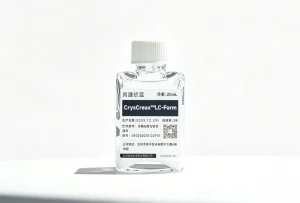
Some emulsion systems are designed to form lamellar liquid-crystal structures. If that is part of the formulation goal, the structure should be treated as one variable within the full stability assessment rather than as a substitute for it.
LANDIVINE describes CrysCrux™ LC-Form as a liquid-crystal enhancer that can be added to an existing emulsification system to induce or strengthen lamellar liquid-crystal structure. Its current page does not publish a confirmed addition level or formulation window. A formulator should therefore verify the technical conditions for the selected base before assigning it a role in a development plan.
Check Formula Variables Before Comparing Prototypes
A useful emulsion formulation development plan keeps the important variables visible. If several things change at once, a better-looking sample may not reveal which change produced the result.
- Oil phase: record the oils, esters, waxes, oil-soluble actives, and their proportions.
- Water-phase additions: note humectants, salts, polymers, extracts, and other materials that may affect ionic strength or rheology.
- pH: measure it at a defined stage and temperature rather than assuming it stayed constant after an ingredient change.
- Addition order: document when each material entered the batch and whether it was pre-dispersed, dissolved, or added directly.
- Temperature and mixing history: keep enough process detail to reproduce a prototype and compare it with the next one.
This is especially important when an active raw material brings its own carrier, solvent, salt, or polymer into the formula. The visible change may come from the complete commercial material rather than from the named active alone.
Read the Signs of Emulsion Instability
Physical instability is easier to troubleshoot when the observed change is described precisely. “The cream separated” is a useful warning, but it is not yet a diagnosis.
| Observed change | What it may indicate | What to check next |
| Creaming or sedimentation | Droplets are migrating through the continuous phase and becoming concentrated in one region. | Compare droplet distribution, density difference, continuous-phase rheology, and whether the change is reversible. |
| Flocculation | Droplets are associating in clusters while remaining distinguishable. | Check microscopy or another suitable droplet-observation method and compare the same sample without unnecessary preparation changes. |
| Coalescence | Droplets are merging into larger droplets, which can move the system toward irreversible separation. | Review droplet-size changes together with emulsifier choice, oil-phase changes, and process history. |
| Viscosity drift | The continuous structure or ingredient interactions may be changing. | Repeat the measurement under the same conditions and compare it with appearance and droplet observations. |
These signs should be interpreted together. A formula can show a viscosity change without visible separation, or droplet aggregation before a strong macroscopic change appears. The goal is to connect what is observed with the next test, not to force every problem into one explanation.
Design Stability Checks Around the Final Emulsion
Prototype stability should be evaluated with a consistent plan that fits the actual product and its package. A single accelerated condition or a short observation period cannot automatically be converted into a universal shelf-life claim.
For physical stability work, useful observations can include:
- appearance, color, odor, and visible phase separation;
- viscosity or rheological behavior measured under defined conditions;
- pH, when it is relevant to the formula;
- droplet observations or particle-size information when the method is appropriate;
- changes after selected temperature or handling conditions that match the project risk;
- interaction with the intended package where product-package compatibility may matter.
Keep the method consistent between checkpoints. If sample preparation changes between measurements, the analytical result may describe the preparation step as much as the original emulsion. Physical stability work should also be kept separate from microbiological, chemical, safety, and efficacy evaluations, which answer different questions.
Turn the Findings into the Next Development Step
A strong development cycle uses each result to narrow the next decision.
- If a new emulsion system is being built: confirm the continuous phase, oil-phase composition, target texture, and candidate emulsification approach before fine-tuning sensory details.
- If the base emulsion is already usable but the structure needs adjustment: define whether the goal is rheology, liquid-crystal structure, sensory change, or another measurable property. Do not assume one structural additive will solve every type of instability.
- If a new active or commercial ingredient changes the emulsion: compare the original formula with a controlled version that isolates the new variable as far as practical. Then check pH, rheology, droplet behavior, and other relevant observations before making several more changes.
This approach keeps cosmetic emulsion formulation development tied to evidence. It also makes supplier discussions more useful because the formulator can describe the system and the observed problem rather than asking for a generic “stable emulsifier.”
What to Prepare Before Discussing an Emulsion Project
When a project requires ingredient or formulation support, prepare enough information for the supplier or technical team to understand the system. A concise technical brief can include:
- the intended product format and, if known, O/W or W/O structure;
- the main oil-phase materials and approximate phase design;
- the target texture and sensory direction;
- the key active ingredients or difficult-to-formulate materials;
- known pH, electrolyte, temperature, or packaging constraints;
- what changed in the unstable prototype and when it appeared;
- the measurements or observations already collected.
LANDIVINE develops cosmetic ingredients and provides formula-development support for B2B projects. If you are assessing an emulsification system, CrysCreax™ Emulsifier, CrysCrux™ LC-Form, or another formulation route, you can discuss your emulsion formulation requirements with LANDIVINE and provide the formulation conditions that need to be checked.
Frequently Asked Questions
Does a higher viscosity mean a cosmetic emulsion is more stable?
Not by itself. Higher viscosity can slow droplet movement, but stability also depends on the condition of the dispersed droplets, the emulsifying system, formulation interactions, and storage conditions. Compare viscosity with appearance, droplet observations, and changes over time rather than using one number as the complete stability result.
Can one emulsifier work in every cream and lotion formula?
No general statement like that can be made from the ingredient name alone. Emulsifier performance depends on the emulsion type, oil phase, active ingredients, electrolytes, pH, processing conditions, and target texture. Product-specific technical information and finished-formula testing are needed before a system is accepted for a commercial formula.
What should be checked after adding a new active ingredient to an emulsion?
Start by checking what changed besides the active itself. The commercial ingredient may add solvent, salts, polymers, or other carriers. Compare pH, viscosity, appearance, droplet behavior, and processing history with the original base. A controlled comparison is more useful than changing several ingredients at the same time.
Is a visible liquid-crystal structure enough to prove long-term stability?
No. Liquid-crystal structure can be an important formulation feature, but it does not replace stability evaluation of the final product. The complete emulsion still needs appropriate physical observations under defined conditions, and other assessments may also be needed for microbiological, chemical, safety, or efficacy questions.
Conclusion
Cosmetic emulsion formulation development works best when each decision has a clear purpose. Define the emulsion system, assign ingredients to specific functions, control the variables between prototypes, and interpret physical changes with more than one observation. This gives formulators a clearer basis for choosing the next experiment and for discussing ingredient options with LANDIVINE without relying on unsupported assumptions about dosage, process conditions, or guaranteed stability.