Solubility matters in cosmetic formulation development because it helps determine whether the intended amount of an active can remain dissolved in the medium that actually carries it. A clear premix is only a starting observation: dilution, pH adjustment and storage can change that environment. Good development therefore connects the active concentration, the composition of its carrier and the conditions the finished formula will encounter.
For a brand discussing an ingredient-led formulation with LANDIVINE, the useful question is not simply, “Does this ingredient dissolve?” It is, “Can the required active content remain in the intended state in this particular formula?” Answering that question early makes later observations—crystals, haze or a falling assay result—much easier to interpret.
Separate Solubility from Dissolution and Dispersion
What is dissolved, and what is only dispersed?
Solubility is an equilibrium property of a specified solute–solvent system under stated conditions. Dissolution describes the process of getting material into solution. Stirring can help a material dissolve more quickly without demonstrating that the final concentration is below its solubility limit. Likewise, a batch that looks uniform may contain finely dispersed material rather than a true solution.
Keep three formulation states separate when discussing an active ingredient:
| State | What the formulation contains | What the developer needs to establish |
| Molecular or ionic solution | Active present as dissolved molecules or ions in the relevant medium | Whether the target concentration remains soluble under the intended conditions |
| Particle dispersion | Undissolved material distributed through a continuous phase | Whether the chosen particle state and distribution remain suitable for the product |
| Carrier-associated system | Active associated with structures such as micelles or a formulated carrier | How the carrier and active behave after incorporation into the finished formula |
These are different development routes, not a ranking from good to bad. An intentionally dispersed product does not have to become a molecular solution to be useful. Conversely, a clear-looking system does not prove that every ingredient is molecularly dissolved. Appearance is a screening observation; the intended physical state determines the next test.
This distinction also prevents an unhelpful response to a failed batch: more mixing is not automatically the answer. Before extending the process, decide whether the problem is incomplete dissolution, insufficient equilibrium solubility or an unstable dispersion. Each points to a different experiment.
Calculate the Active Load in the Phase That Carries It
The percentage printed in a finished-formula worksheet is not always the concentration experienced by the active. An ingredient assigned to a relatively small carrier phase can have a much higher local concentration than its overall formula percentage suggests.
Consider this hypothetical mass-balance example, not a recommended formula:
The active content in the complete product is:
0.20 g ÷ 100.0 g × 100 = 0.20% by mass.
Within the assumed carrier phase, the active concentration is:
0.20 g ÷ 10.0 g × 100 = 2.0% by mass.
Both figures are correct; their denominators differ. The 2.0% figure is the relevant starting load for that assumed phase, but the calculation does not establish that 2.0% is soluble. A solubility result would still need to describe an appropriate medium and conditions.
The assumption that all active occupies one phase is important. If it partitions between phases or associates with a carrier, its distribution needs a different assessment. Do not simply divide by the oil-phase mass because an ingredient is described as oil-compatible. First establish what the concentration is intended to represent.
Also distinguish commercial-ingredient addition from active addition. A supplied solution or blend is not necessarily pure active. Use its confirmed quantitative composition to calculate delivered active content; an INCI listing alone does not supply that percentage. This is especially useful when comparing two raw materials offered in different carriers: compare the amount of active and the carrier contribution, not just equal percentages of the supplied ingredients.
Explain Why a Clear Premix Can Fail After Dilution or Cooling
Changes in solvent composition and pH
Adding water to a premix lowers the active concentration, but it can also make the surrounding solvent mixture less favorable to that active. These two changes work on different parts of the problem. Dilution therefore cannot be assumed to prevent precipitation simply because the overall active percentage becomes smaller.
A useful development comparison follows the material through the actual sequence: the initial premix, the diluted blend and the completed formula. Keep the final composition explicit. Comparing a concentrated ingredient with the finished product without accounting for its changed medium leaves the central question unanswered.
For ionizable ingredients, pH can also change the balance between molecular and ionic forms. Ferulic acid illustrates why this needs attention. Published research by Das and Wong examined its behavior in relation to pH and separately assessed crystallization and chemical content. The lesson for formulation work is to investigate the intended final conditions, rather than assume that a convenient dissolution step establishes a stable finished product.
When an adjustment is needed, test it in the relevant formula. A pH change may influence more than the active being investigated, and a reading from the premix is not a substitute for the final product’s pH.
Processing temperature versus storage conditions
A material incorporated during a warm process must also be assessed after the product reaches its intended storage conditions. The direction and size of a temperature effect depend on the ingredient and medium; not every active becomes less soluble to the same extent on cooling.
Treat a warm, clear premix as a sample taken at one point in a process. Follow it through cooling and an appropriate holding period. A single observation immediately after manufacture cannot establish the absence of later crystallization.
For practical screening, organize observations around the change being studied:
| Formulation change | Useful comparison | Question being investigated |
| Premix diluted into the main batch | Premix and final blend at defined conditions | Does the changed medium still support the intended active state? |
| pH adjusted during development | Matched formulas differing in the planned pH adjustment | Is the active’s physical state sensitive to that adjustment? |
| Warm processing followed by cooling | Samples before and after a controlled temperature history | Does the cooled formula retain the intended state? |
| Storage over time | Initial and later samples assessed by the same methods | Is a change delayed rather than absent? |
These comparisons are a proposed investigation sequence, not a universal stability protocol. They identify where a change occurs so that the next experiment can be focused.
Choose a Solubility Strategy Without Ignoring Chemical Stability
A solubility problem can be approached by changing the medium, reconsidering active loading or selecting a different commercial delivery form. The best route depends on which requirement is fixed and which can be changed.
Changing the medium is worth investigating when the active target is necessary but the present vehicle cannot support it. Assess the complete solvent blend and its consequences for the finished formula, rather than adding a cosolvent solely until a beaker looks clear. A successful premix must still survive incorporation.
Revisiting the target load is useful when a concept has adopted an ingredient percentage without establishing the delivered active content or final-phase concentration. Recalculate those quantities first. Reducing the load is a formulation decision, not proof that the revised product will retain the same performance claims.
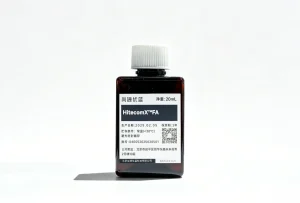
Selecting an appropriate supplied form can change the incorporation route. LANDIVINE’s HitecomX™ FA ferulic acid ingredient lists Ferulic Acid / Phospholipids and is described as an oil solution for essence oils, creams and lotions. That is relevant to the choice of carrier and finished-product format. It does not mean that the supplied material behaves like neat ferulic acid, or that its compatibility in every finished formula has already been established.
Chemical stability remains a separate requirement whichever route is chosen. Wang and colleagues’ study of ferulic acid in cosmetic prototypes reported pH- and temperature-related instability under its experimental conditions. Improving incorporation or clarity is therefore not, by itself, evidence that active content is being preserved.
Avoid reducing a complex study to a universal rule such as “higher pH is better” or “this carrier guarantees stability.” Compare alternatives in the intended base and measure the property each change is meant to improve. A change that solves precipitation but creates unacceptable chemical loss is not a complete solution.
Test for Crystals and Active Loss as Separate Failure Modes
Observe physical changes and measure chemical content
Physical-state observations and chemical analysis answer different questions. Microscopy or another suitable particle assessment can help examine suspected crystals; an appropriate assay can track the amount of chemically intact active. Neither should be used to claim more than it measures.
There is also a sampling issue. An assay performed after extracting the entire sample may recover active that was originally dissolved as well as active that had precipitated. A normal total-content result would then not prove that the original formula remained a true solution. Conversely, a result obtained from a separated liquid fraction describes that fraction and must be interpreted with the separation method in mind.
This is a method-design consideration, not a reason to abandon either test. Decide whether the question concerns total active recovery, dissolved active, particle formation or degradation, then use sample preparation that can answer it.
| Observation or measurement | What it helps establish | What it does not establish alone |
| Visible haze or sediment | The appearance has changed | The identity or chemical cause of the change |
| Microscopy of a representative sample | Whether particulate or crystal-like material is present | The total amount of chemically intact active |
| Appropriate whole-sample active assay | Active recovered by the specified analytical method | Whether that active was dissolved before extraction |
| Comparison of defined sample fractions | How active is distributed under that sampling method | A universal equilibrium solubility without further validation |
A declining assay result should also trigger a review of sampling and recovery before every loss is attributed to degradation. An uneven sample, incomplete extraction or an unsuitable method can complicate the interpretation.
Compare the premix with the finished formula
A practical screening plan can include the base without the active, the ingredient premix and the completed active-containing formula. Sample the points where the environment changes: after incorporation, after final adjustment and after the selected storage interval. Use comparable observation and analytical methods.
The base helps identify changes that are not unique to the added active. The premix helps locate whether the issue begins before incorporation. The final formula is the material that must meet the product brief. These comparisons narrow the cause; they are not replacements for a finished-product validation program.
LANDIVINE’s cosmetic formulation development range provides a starting point for discussing the intended product format alongside ingredient selection. The most useful brief connects the target active content, supplied raw-material form, carrier system and conditions under which a problem appears.
Solubility becomes useful to development when concentration and conditions are defined together. To discuss your active-ingredient formulation with LANDIVINE, describe the intended finished format, the active-containing raw material, its proposed addition and any changes observed after incorporation. This keeps the discussion focused on the actual formulation problem rather than a general claim that an ingredient is soluble.