해양조류가 실제로 어떤 용도로 사용되는지 검색 중이라면 사양, 공급업체 또는 규정을 자세히 알아보기 전에 명확한 답변이 필요할 것입니다. 간략히 설명하자면, 해양 조류는 겔화제 및 농축제(한천 및 카라기난)로 식품에, 질감 및 캡슐화에는 알지네이트로, 동물 사료, 농장의 생물 자극제 및 비료, 화장품, 기능성 식품에 나타나며 증거는 아직 초기 단계입니다.
이 가이드는 각 주요 용도를 살펴보고 각 용도에 중요한 구매자 사양과 장단점을 보여주고 나란히 비교합니다. 또한 구매자가 종종 막히는 두 가지 영역, 즉 야생 수확이 실제로 더 저렴한 투입물인지 여부와 EU 및 미국 규정이 판매할 수 있는 품목을 어떻게 변경하는지 다룹니다. 이미 기본 사항을 알고 있고 소싱이나 제품 결정을 내려야 하는 중간 구매자를 위해 작성되었습니다.
1. 식품 하이드로콜로이드: 홍조류에서 추출한 한천과 카라기난
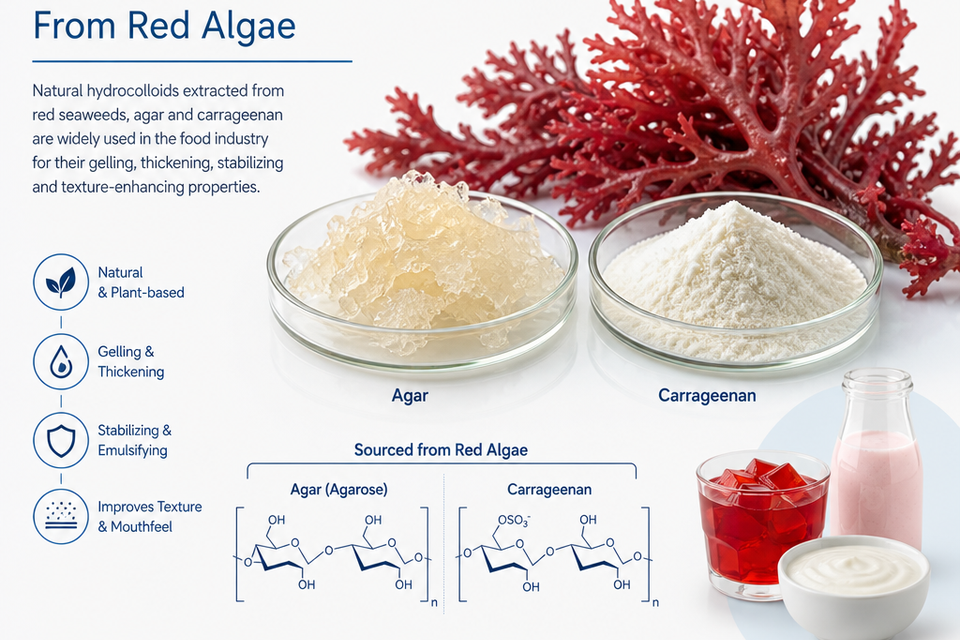
1에 대한 그림. 식품 하이드로콜로이드: 홍조류의 한천과 카라기난
Agar and carrageenan from red algae are mature, plant-derived gelling agents. Agar comes mainly from Gracilaria. Carrageenan comes mainly from Kappaphycus 그리고 Eucheuma. Food makers use both to gel, thicken, and stabilise dairy, meat, confectionery, and plant-based products.
Why buyers choose them
- Proven performance: Long commercial use means application behaviour is well documented.
- Clean-label fit: Both are plant-derived, which supports ingredient positioning.
Specs to request
- Agar gel strength, in g/cm²
- Carrageenan viscosity and gel behaviour
- Sulfate content
- Certificate of analysis covering heavy metals and microbiology
Pros and cons
- Pro: Supply chains are mature, and application results are predictable.
- Con: Prices track Kappaphycus harvest variability.
- Con: Grade mismatches cause reformulation risk.
Rating
- 4.5/5 for food manufacturers with existing gel formulations.
- 3/5 for new entrants without grade-testing capacity.
Why wild biomass is not always cheaper
Some might argue wild-harvested macroalgae avoids farm costs. However, three factors can erase that advantage:
- Seasonal variability: Lean seasons force spot buying at higher prices.
- Collection logistics: Transport from shore to plant adds fuel cost and spoilage risk.
- Cleaning: Sand, epiphytes, and debris need removal before processing.
Cost-to-scale model for feed and biostimulant producers
Populate each variable from supplier quotes and peer-reviewed yield studies. Do not use unverified figures.
- Yield per hectare (dry t/ha/year): peer-reviewed studies
- Harvest and logistics cost (USD per wet t): haulier quotes
- Dry fraction (dry t per wet t): your processor’s data
- Processing and cleaning cost (USD per dry t): processor quotes
- Annual fixed costs (USD/year): equipment and facility quotes
Use these formulas:
- Cost per dry tonne = (harvest and logistics cost ÷ dry fraction) + processing and cleaning cost
- Break-even volume (dry t/year) = annual fixed costs ÷ (selling price − cost per dry tonne)
Run the model at the lowest and highest seasonal yields. If break-even volume swings widely, wild supply carries too much risk for a fixed investment.
Implementation risks
- Test every incoming lot against your gel specification.
- Avoid single-region sourcing when a harvest fails.
2. Alginates From Brown Algae for Texture and Materials
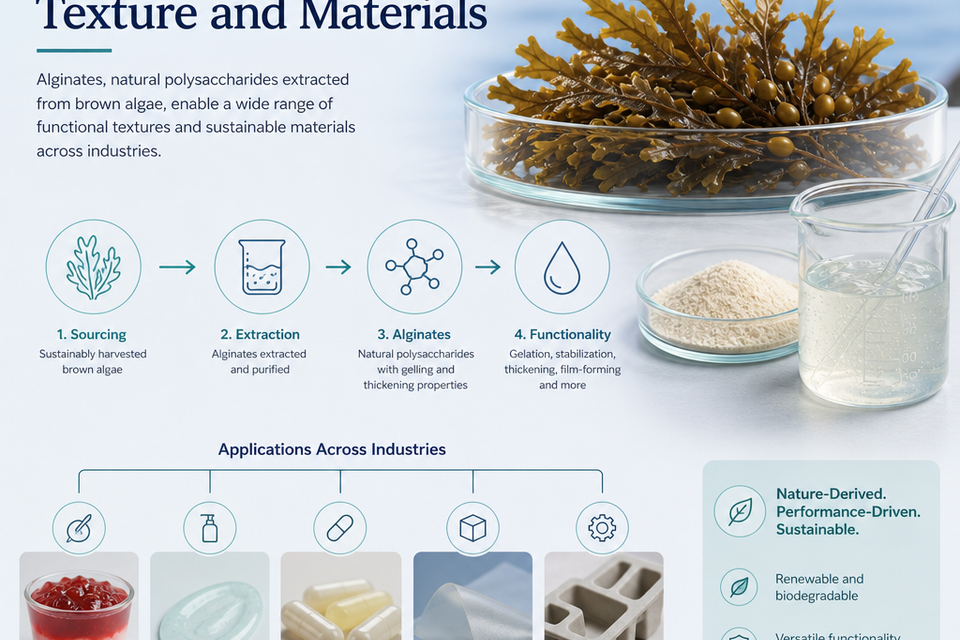
Illustration for 2. Alginates From Brown Algae for Texture and Materials
Brown algae such as Laminaria (kelp) and Ascophyllum supply alginate, a polymer that thickens, gels, and forms films. Its main advantage is that calcium triggers gelation, so you can form beads, gels, and coatings without heat.
1. Food texture and encapsulation (Rating: 4/5)
- Use: Thickeners, stabilisers, and beads for controlled release.
- Specs to request: Viscosity or molecular weight range, M/G block ratio, and calcium sensitivity data.
- Pros: No heat step, so heat-sensitive ingredients stay intact.
- Cons: M/G ratio varies by species and season, so each batch needs testing.
2. Pharmaceutical excipients
- Use: Matrix for encapsulation and controlled-release formulations.
- Specs to request: The same core set as food grade, plus confirmation of grade against your pharmacopoeia requirements.
- Pros: One raw material family serves both food and pharma uses.
- Cons: Pharma-grade qualification adds documentation work for your team.
3. Biodegradable packaging films (Rating: 3/5)
- Use: Film-forming material for packaging.
- Specs to request: Viscosity range, M/G ratio, and consistency data across several lots.
- Pros: Biodegradable polymer from a renewable raw material.
- Cons: Materials use is still largely at pilot stage, so commercial scale-up carries risk.
Decision test: Run two lots with different M/G ratios through your own gel test at your calcium dose. If bead shape or gel strength falls outside your spec window, write batch M/G testing into the supplier contract.
Before any claim: Check EU food additive authorisation under Regulation (EC) 1333/2008, relevant EFSA opinions, and the FDA GRAS notice inventory. Confirm timelines and documentation requirements against these primary sources first.
3. Animal Feed and Aquaculture Nutrition
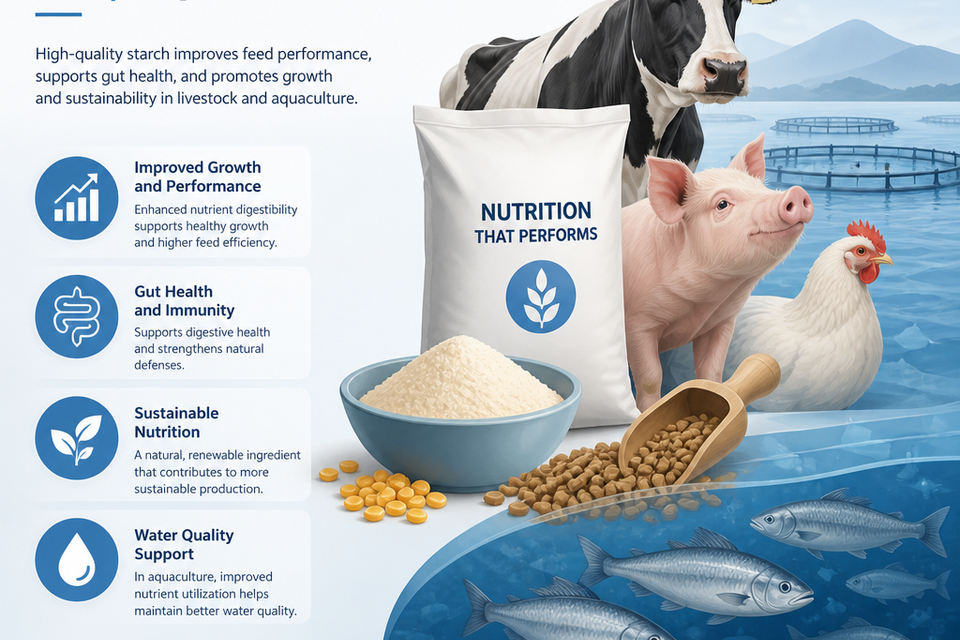
Illustration for 3. Animal Feed and Aquaculture Nutrition
Marine algae work in animal and aquaculture feed as a functional supplement, not a main protein. They supply minerals, pigments, and polysaccharides, and some studies report better feed conversion or immune markers at low inclusion rates. We rate them 3.5/5 as a supplement 그리고 2/5 as a primary protein source at current economics.
Before you test anything, ask which step blocks you first. For feed, that is usually market access, not performance.
Use this three-step screen:
- Check regulatory eligibility. Confirm that your target market approves the algae species and inclusion level for feed. Approval varies by country, and a product that lacks approval cannot enter the market, however well it performs.
- Set grade parameters. Write the specification before you request samples. For feed, set limits on moisture, iodine, and heavy metals. For red algae used as a hydrocolloid ingredient, add gel strength, viscosity, and sulfate content. Ask for batch-level data, not a single certificate.
- Shortlist the genus. Match candidate species to your parameter sheet. Ask whether the supplier has trial data for your species and animal.
Pros:
- Supports a clean-feed story.
- Grows on coastal sites without freshwater or arable land.
Cons:
- High moisture limits how much you can include.
- Iodine and heavy-metal levels vary between batches.
- Most trials are short and species-specific. Treat any inclusion-rate claim as dependent on its study design.
Implementation risk: Iodine variation is the main risk. Test at least three batches before you fix an inclusion rate. If readings swing, lower the rate instead of trusting the average.
Pricing: Public price context for feed-grade algae is limited, so compare landed-cost quotes per specification, not per tonne list price.
To move to sourcing, review the marine algae product page or explore 신소재 개발 for custom specifications.
4. Agricultural Biostimulants and Fertilisers
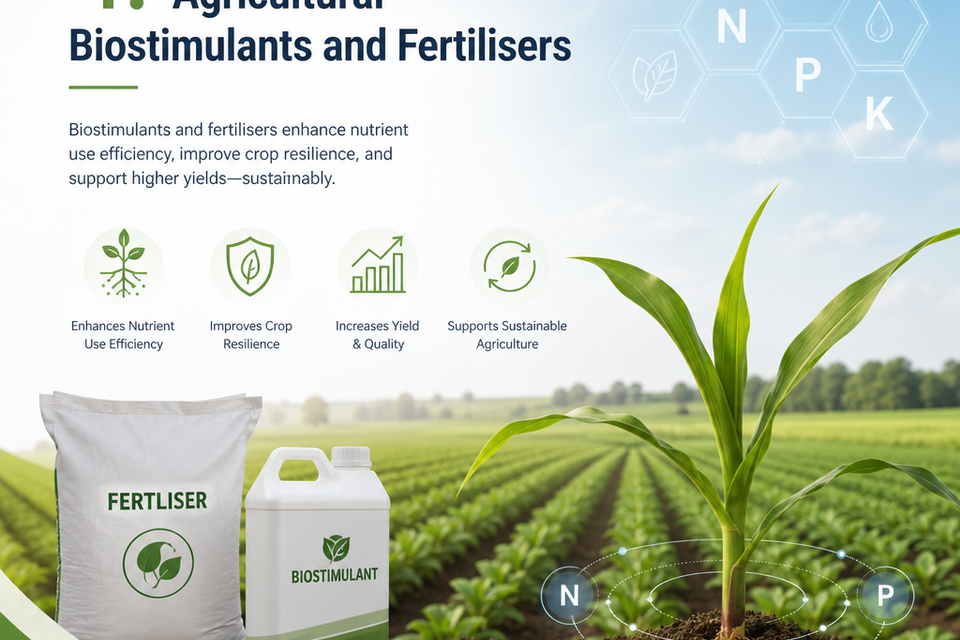
Illustration for 4. Agricultural Biostimulants and Fertilisers
Seaweed extracts from Ascophyllum, Ecklonia, 그리고 Laminaria work as biostimulants. They help crops handle stress and take up nutrients. Adoption is strongest in horticulture and turf.
Where it fits
- Horticulture buyers with extract-standardisation requirements: 4/5
- Broadacre use without local trial data: 3/5
Pros: Strong commercial adoption and a growing body of trial literature. Cons: Performance varies by crop, soil, and extraction method. However, many field claims lack independent replication.
Regulatory check: In the EU, biostimulant claims and CE marking fall under Fertilising Products Regulation (EU) 2019/1009. Confirm the component material category before you market anything.
Illustrative scenario (hypothetical, numbers are placeholders)
A fictional mid-sized feed producer needs 50 tonnes of dried algae a year. It weighs contract-growing 울바 against buying processed meal.
- Feed-safety testing: Set the test plan before you commit. Illustrative: a contract grower may need two seasons of trials before the first harvest. A meal supplier may ship within a month, but you still test each lot.
- Heavy-metal screening: Macroalgae can absorb metals from water. Illustrative: set a lot-release limit and reject any batch above it. Growing your own gives control over the site, but supplier certificates alone give you only paperwork.
- Supply continuity: Illustrative: one grower covering 20 tonnes leaves a gap if a season fails. Two suppliers reduce that risk but raise audit costs.
Questions to send suppliers via the 연락처 페이지:
- Which material category applies, and how did you classify it?
- Which heavy metals do you test, how often, and can we see batch records?
- How many seasons of yield and composition data do you have?
- What backup supply plan covers a failed harvest?
- What is your delivered cost per tonne of dry matter at each volume tier?
5. Personal Care and Cosmetic Ingredients

Illustration for 5. Personal Care and Cosmetic Ingredients
Algae extracts and polysaccharides mainly work in skincare and haircare as thickeners, film formers, and moisturisers. Some suppliers also market them as active ingredients. Marine origin fits natural and organic positioning, which helps consumer appeal.
Pros: High margin potential and strong brand storytelling.
Cons: Many efficacy claims rest on in-vitro or small-panel data. Supplier consistency for extract profiles can be weak.
Ratings:
- 3.5/5 for brands with substantiation budgets
- 2.5/5 for claims-led launches
Check EU compliance first. List each ingredient under its INCI name, confirm it in the CosIng database, and verify restrictions under Regulation (EC) 1223/2009 before you commit to a formula.
Illustrative scenario (hypothetical): A fictional mid-sized skincare brand chooses between buying a standardised seaweed extract and co-developing one with a supplier. It works through three gates:
- Compliance: Confirm the INCI name and CosIng listing. A restriction ends the option early.
- Consistency: Request lot-level specs and heavy-metal results. Placeholder: three lots within [X]% variation (illustrative only).
- Substantiation: Decide whether to fund a small panel. Placeholder: [X] participants at [X] cost (illustrative only).
Pricing varies by supplier, so set your own budget ceiling before comparing quotes.
Implementation risks: Claims may face challenge, extract profiles can shift between lots, and supply gaps can force reformulation.
Questions to send suppliers via the 연락처 페이지:
- Which INCI name and CosIng entry apply?
- What lot-to-lot variation do you guarantee?
- Which heavy-metal and microbial tests run per lot?
- What substantiation supports each claim?
Adapt these questions with your own verified data.
6. Nutraceutical and Bioactive Compounds: Fucoidan and Phycocyanin
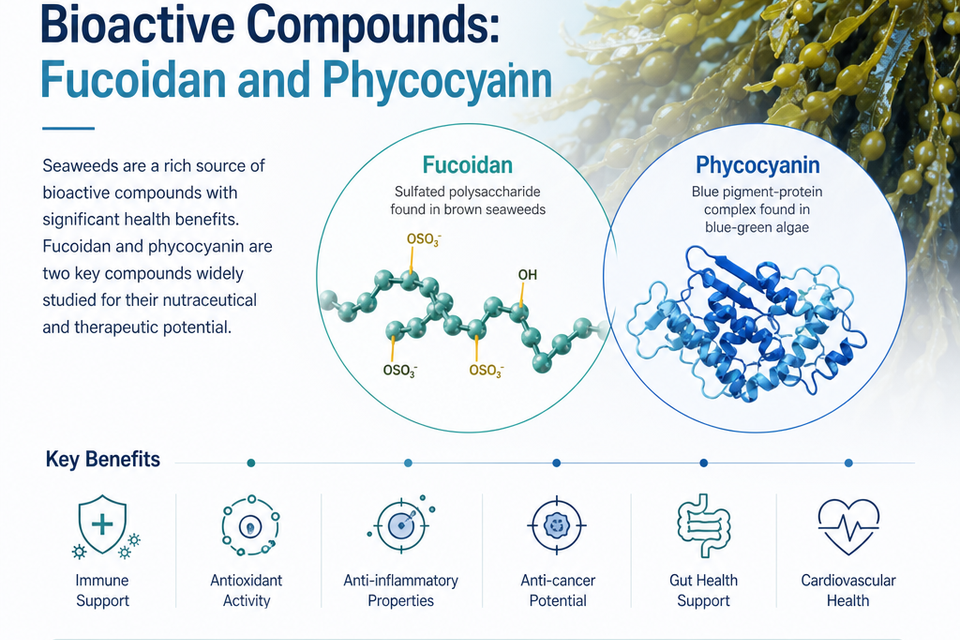
Illustration for 6. Nutraceutical and Bioactive Compounds: Fucoidan and Phycocyanin
Fucoidan and phycocyanin are sold for antioxidant, anti-inflammatory, and immune-support benefits. Most of the evidence is still early, so treat them as research-stage supplement ingredients, not proven treatments.
Fucoidan is a sulfated polysaccharide from brown seaweeds. Phycocyanin is a blue pigment-protein complex. Phycocyanin in spirulina comes from a cyanobacterium, not a macroalga, so label it that way when you sell it next to seaweed products.
What the evidence shows
- Most findings come from cell and animal studies.
- Human trials are small and use different designs, so results do not compare cleanly.
- Neither compound has an approved drug indication in major markets.
- Fucoidan quality varies widely in sulfation and molecular weight. Two products labeled “fucoidan” may behave differently.
Pros and cons
- Pro: Strong research interest and premium pricing potential.
- Con: Strict EU and US claim rules.
- Con: Inconsistent raw material makes results hard to repeat.
Recommendation
- 3/5 for supplement developers with budgets for their own clinical trials.
- 1.5/5 for claims-based marketing without trials.
Illustrative scenario (hypothetical)
A fictional feed producer, “Northfield Feeds,” weighs contracting Ulva cultivation against buying dried algae meal. All numbers below are placeholders, not market data.
- Feed-safety testing: Require pathogen and contaminant panels on every batch from either route.
- Heavy-metal screening: Set limits for cadmium, lead, arsenic, and mercury before tendering. Assume a contract grower’s first-season lots fail 1 in 10 (illustrative). Add a pre-harvest water test if that happens.
- Supply continuity: Northfield needs 40 tonnes of dry meal monthly (illustrative). Confirm whether a single grower site can cover that, or whether a backup supplier is needed.
- Decision rule: Choose cultivation only if cost per tonne of usable dry matter stays below the bought price after testing and backup costs.
Questions to send suppliers via the 연락처 페이지:
- Which species and harvest region do you supply?
- Can you share batch-level heavy-metal and microbial results?
- What is your minimum monthly volume, and what is your backup capacity?
- Which regulatory filings cover feed use in our target market?
- What is your lead time from order to delivery?
Comparison Table of Marine Algae Uses at a Glance
Start with the use, then match the genus, buyer specs, and regulatory route. The table below covers six common uses. Ratings reflect commercial readiness for an intermediate buyer, not scientific importance.
| Use category | Primary genera | Key buyer specification | Main regulatory route | Evidence maturity | Recommendation rating |
| Food hydrocolloids | Gracilaria, Kappaphycus | Gel strength, viscosity, heavy metals | Food additive authorisation | Established | High |
| Alginates | Laminaria, Ascophyllum | Guluronic/mannuronic ratio, viscosity | Food additive authorisation | Established | High |
| Feed | Mixed brown and red species | Protein, moisture, contaminant limits | Feed materials rules | Varies by species | Medium |
| Biostimulants | Ascophyllum, Ecklonia | Dry matter, extract composition, heavy metals | EU Regulation 2019/1009 | Growing | Medium |
| 화장품 | Mixed extracts | INCI name, batch consistency, microbial limits | EU Regulation 1223/2009 | Varies by extract | Medium |
| Nutraceuticals | Fucus or Undaria-derived fucoidan | Confirmed species origin, purity | Market-specific (novel food or GRAS) | Verify origin | Lower |
Source your raw material early. If you need a custom grade, see 신소재 개발.
Illustrative scenario (hypothetical): A fictional feed producer compares contracting 울바 cultivation against buying dried algae meal. Placeholder numbers: meal at €800/t; contract supply at €650/t delivered.
- Feed safety: Confirm the product fits the feed materials rules. Test three lots for microbes and mycotoxins.
- Heavy metals: Screen for cadmium, lead, mercury, and inorganic arsenic. Total arsenic alone hides the risk.
- Supply continuity: Ask how seasonal yield changes. Require a backup supplier before signing.
In this example, the producer buys meal for year one and runs a small cultivation pilot. Replace these numbers with your own verified data.
Questions to send suppliers via the 연락처 페이지:
- Which feed materials listing covers your product?
- What are your lot-level heavy-metal results, including inorganic arsenic?
- How does monthly yield vary across the year?
- What is your minimum order and delivery lead time?
Counter-Argument: Is Wild-Harvested Algae Really the Cheaper Input?
Not always. Wild harvest has a lower entry cost, but seasonal swings, travel to collection points, and cleaning losses can erase the gap. Compare delivered, usable cost per tonne, not the harvest price.
Step 1: Calculate break-even volume
Break-even (t/year) = Fixed annual costs ÷ (Selling price per tonne − Variable cost per tonne)
Fill each variable (dry yield per hectare, processing cost, transport cost, cleaning loss) from supplier quotes or peer-reviewed yield studies. Record the source and date beside each value.
Step 2: Test the numbers with an illustrative scenario
A fictional feed producer needs 500 t/year of dried algae meal. All figures below are placeholders, not market data:
- Wild route: $200/t dry raw. A 30% cleaning loss leaves 70% usable, so the raw cost becomes about $286 per usable tonne. Add $80 processing and $40 transport: roughly $406/t.
- Cultivated contract: $380/t delivered, usable (illustrative quote).
Wild looks cheaper at $200. After cleaning loss, it costs more.
Step 3: Pass each decision gate
- Feed-safety testing: Confirm each lot meets your feed-material specification. One failed lot can stop the route.
- Heavy-metal screening: Test every lot for arsenic, cadmium, lead, and mercury. Harvest location drives variation, so one clean batch does not prove the season.
- Supply continuity: Map months with no harvest. If wild supply leaves gaps, you need a second supplier, which adds cost.
Some might argue wild supply suits a flexible buyer. However, the seasonal gap usually reverses that advantage.
Limitation: Your model is only as reliable as its inputs. Sensitivity-test yield and price, for example ±20%, before committing capital.
Checklist for suppliers (send via the 연락처 페이지):
- What dry yield per hectare does your quote assume, and what is its source?
- What cleaning loss percentage applies, and how do you measure it?
- Is your price delivered, and what transport terms apply?
- Which months can you supply, and what is the minimum order?
- Can you provide feed-safety and heavy-metal reports for each lot?
- What documentation supports registration for my target market?
Common Sourcing Mistakes Practitioners Make With Marine Algae
Most sourcing mistakes with marine algae start with buying by use name, such as “agar algae,” instead of by the grade parameters your product needs. A genus name tells you little about whether a lot meets your gel strength or contaminant limits.
Mistake 1: Accepting a generic certificate of analysis (CoA)
- Why it fails: Many CoAs report moisture and ash but skip the values that drive performance.
- Fix: Request gel strength, viscosity, and sulfate data for every lot before you sign.
Mistake 2: Treating feed-grade and food-grade as interchangeable
- Why it fails: Each grade has its own contamination limits and labelling rules. Material that passes feed checks can fail food requirements.
- Fix: Confirm the grade and test panel in writing before ordering.
Mistake 3: Launching a claims-led product first
- Why it fails: A claim allowed in one market may be restricted in another.
- Fix: Confirm what you can legally state in the target market before you print labels.
Mistake 4: Ignoring seasonal batch variation
- Why it fails: Algae composition shifts with season and harvest site. A formula that works in batch one can drift by batch two, forcing reformulation.
- Fix: Set an acceptable range for key parameters and test each lot against it.
Illustrative scenario (hypothetical, placeholder logic only): A mid-sized feed producer compares contracting 울바 cultivation with buying processed dried algae meal.
- Feed-safety testing: Both options need lot-level testing. The meal supplier offers CoAs per lot; the cultivation contract needs testing per harvest area.
- Heavy-metal screening: Reject any lot above the limit in the target feed regulation.
- Supply continuity: Cultivation exposes the producer to weather and site risk. Meal depends on supplier stock and lead times.
Checklist to send suppliers via the 연락처 페이지:
- Which gel strength, viscosity, and sulfate values do you report per lot?
- Which feed or food grade does this lot meet, and which test panel supports it?
- What heavy-metal results do you provide, and how often?
- How much does composition vary by season, and what range do you guarantee?
- What is your backup supply plan if a harvest fails?
Regulatory Pathways by Market: EU Versus US
Regulatory eligibility decides which markets an algae product can enter, so check it before you compare prices. The EU and US use different systems, and the same dried algae can need very different paperwork in each.
EU: Food ingredients need a novel food assessment under Regulation (EU) 2015/2283, with an EFSA opinion as the key primary source. Fertilisers and biostimulants fall under Regulation (EU) 2019/1009, where you confirm the component material category and conformity route.
US: Food ingredients rely on GRAS status. Check the FDA GRAS notice inventory, then determine whether self-affirmation or formal notification applies.
Cosmetics: Check EU CosIng and US ingredient listings, and confirm restrictions before you finalise the formulation.
Timelines and documentation change over time. Confirm them against primary sources before any market entry decision.
Illustrative scenario (hypothetical, placeholder numbers only): A mid-sized feed producer weighs contracting Ulva cultivation against buying processed dried algae meal. It works through three gates:
- Feed-safety testing: Does the supplier provide batch records for contaminants and microbiology? Placeholder: two tested batches per quarter.
- Heavy-metal screening: Compare results against the limits in your target market. Placeholder: reject any batch that fails, and budget for re-testing.
- Supply continuity: Model a poor harvest. Placeholder: two suppliers cover a 30% shortfall.
Some buyers assume cultivation cuts cost. However, a grower still needs the same testing and documents, so price the compliance work into both options.
Checklist for suppliers (send via the 연락처 페이지):
- Which regulatory pathway applies in each target market, and which documents exist?
- Which species and harvest region do you use, and can you show traceability?
- Which heavy-metal and microbiology results come with each batch?
- What backup supply plan covers a failed harvest?
- Which contract terms cover recalls and test failures?
Frequently Asked Questions About Marine Algae Uses
Food hydrocolloids, mainly agar and carrageenan, are the most established commercial use of marine algae. Feed and fertilizer uses are growing, but they depend heavily on local rules and sourcing economics.
FAQ 1: What is the most established use of marine algae?
Agar and carrageenan thicken, gel, and stabilize foods. Their supply chains are mature, so buyers can order to written specifications for gel strength, viscosity, and purity. For sourcing options, see the marine algae product page.
FAQ 2: Is it cheaper to grow or harvest algae?
It depends on volume, seasonality, and processing. Wild harvest suits smaller or seasonal needs. Cultivation gives more control over timing and quality, but it adds capital and operating cost. Run the break-even model in Section 8 and replace every input with your own supplier quotes.
FAQ 3: Can marine algae be used as animal feed?
Yes, as a functional additive in many trials. Feed-grade approval and inclusion limits, however, vary by country and species. Some producers treat trial results as enough. Trial data does not replace registration in your target market.
Illustrative scenario (hypothetical; all numbers are placeholders): “Northfield Feeds,” a fictional mid-sized feed producer, weighs contracting Ulva cultivation against buying processed dried algae meal.
- Feed-safety gate: Confirm the material is approved as a feed ingredient in the target market. Northfield finds that the Ulva route needs an extra registration step.
- Heavy-metal gate: Algae can accumulate metals, so Northfield requires batch testing on every lot. Its planning assumes 10% of batches fail, a placeholder figure.
- Supply-continuity gate: Cultivation risks seasonal and weather disruption. Northfield assumes a 3-month reserve stock.
- Cost gate: Illustrative quote: processed meal at 100 units per tonne versus contracted Ulva at 115 units, plus setup costs. The break-even depends on annual volume.
Northfield chooses processed meal for the first year. Its plan revisits cultivation once volumes and approvals are clear.
FAQ 4: Which algae health claims can be legally made?
Most fucoidan and phycocyanin claims are not approved. Confirm the exact permitted wording in your market before you write any marketing copy.
Checklist for suppliers
Send these questions through the 연락처 페이지:
- Which species and processing method do you supply?
- What feed or food approvals cover this material in my market?
- What heavy-metal and microbial test results come with each batch?
- What is your minimum order, lead time, and seasonal shortfall plan?
- Can you provide written specifications for each grade?
결론
Marine algae is not one market. Food hydrocolloids are the most established use, alginates offer strong texture and encapsulation potential, and feed, biostimulants, cosmetics, and nutraceuticals each carry different levels of evidence and regulatory risk. The right choice depends on which end use clears market access, specification, and performance requirements first, and that is usually where your sourcing decision should start.
Before you commit budget, pull the grade specs from your own application, verify cost inputs with supplier quotes, and confirm the regulatory route in your target market. If you’re ready to compare options, 우리 팀에 연락하세요 to review your specification and get help matching a marine algae grade to your end use.